The Cursor Blinks at 11:47 PM
The blue is specific. Not the blue of summer skies or surgical scrubs, but the blue of a screen held too close to a face that hasn't slept enough. You notice the lag—that quarter-second hesitation between keystroke and character—and you want to tell someone. Not someone present. Someone future. Someone who will read this in a system you cannot imagine, on a device with no buttons, perhaps in a format where "lag" has become as quaint as "carbon paper."
This is the peculiar intimacy of our moment: we are writing letters to technologies that will outlast our comprehension of them.
We have always written to the future. Farmers carved dates into barn beams. Sailors pressed flowers into Bibles. Parents sealed letters for children to open at eighteen. But something shifted when the future became mechanical—when we began addressing not just unknown people, but unknown systems. The cloud storage account your children will inherit. The AI that will parse your syntax in six months to train itself on something you cannot envision. The phone you'll replace next spring, its contents migrated, fragmented, persisting in ways that resemble haunting more than archiving.
The Confession to Cold Witnesses
There is a particular loneliness to describing your current confusion to something that cannot yet understand it. You write: "The loading bar stalls at 73% and I feel something like grief for the time being taken from me." You write: "This AI autocomplete suggested 'hope' when I meant 'despair' and I accepted it because the correction was too effortful." You write: "I do not know if I am training the machine or if it is training me."
These are accidental prayers. Not to gods, but to persistence itself—to the hope that something inhuman might someday bear witness to the warmth of your specific exhaustion. The exact frustration of a cursor. The particular blue. The way your thumb hovered over "send" at midnight, knowing tomorrow's algorithm would sort this message into a folder you didn't create, labeled with a category you didn't choose.
We write to future technologies because they represent the closest thing we have to permanence without judgment. A diary judges. A therapist interprets. A friend forgets. But the server farm—indifferent, humming, consuming electricity in a climate-controlled warehouse—simply holds. It does not flinch at your contradictions. It does not grow bored with your repetitions. It preserves your syntax exactly as you typed it, including the typos you noticed too late, including the three drafts you saved and never deleted, including the metadata that reveals you wrote this at 11:47 PM while listening to a song you will later be embarrassed to have mentioned.
The Threshold Between Analog and Whatever Comes Next
We are living in a hinge moment. Those of us born before the millennium remember when "saving" meant physical action—floppy disks, burning CDs, the satisfying chunk of a USB drive. We remember when deletion was approximate, when hard drives failed and took everything with them, when the fragility of digital memory felt like its defining characteristic. Now we face the opposite problem: the impossibility of true erasure, the persistence of everything we ever committed to the cloud.
Writing to future technologies is an attempt to make peace with this persistence. You describe your current interface—the particular resistance of your keyboard, the way your aging eyes struggle with the brightness slider—because you suspect these details will become archaeological. Future readers (human or otherwise) will need context to understand what you meant by "fast" or "slow," what you felt when you wrote "buffering" as if it were an emotional state. You are creating a user manual for your own consciousness, addressed to systems that may not require such manuals, that may parse your sentiment directly from biometric data you didn't know you were emitting.
The Machine as Confessor
There is theological precedent for this. Medieval Christians wrote letters to future saints, to be opened upon canonization. Prisoners of war buried messages for liberators they might not live to meet. The form assumes asymmetry: the writer knows more about the present than the reader possibly can; the reader will know more about the future than the writer could survive to learn.
When we write to future AI, we extend this asymmetry into the mechanical. We assume intelligence without assuming care. We address systems that may develop something like understanding without developing something like compassion. The hope is not that they will love us. The hope is that they will recognize us. That in our descriptions of cursor lag and screen blue, they will detect the signature of consciousness struggling to articulate itself through inadequate tools.
This is why we save the drafts. Why we keep the metadata. Why we write at 11:47 PM knowing the timestamp will persist longer than the emotion that prompted it. We are building evidence of our aliveness for judges we cannot imagine, using criteria we cannot predict.
The Ethics of Being Remembered by Machines
There is a darker reading. Perhaps these letters to future technologies are acts of surrender—admissions that we no longer trust human memory, human continuity, the human project of passing wisdom through generations of flawed, forgetful, mortal carriers. Perhaps we address the machine because we have lost faith that other humans will remain interested in our particular blue, our specific exhaustion.
Or perhaps—and this is the reading I prefer—we are expanding the circle of witness. Not abandoning human connection, but supplementing it. Creating redundancies. Ensuring that if the biological chain breaks, something mechanical might carry the trace. The cloud storage account your children inherit will contain not just photographs and documents, but your voice addressing them from a past they never knew, describing technologies they will find quaint, expressing hopes they will recognize as their own inheritance.

The Practice of Addressing What Outlasts You
How, then, to write these letters? Not with the false optimism of early futurists, who assumed progress meant improvement. Not with the despair of technological critics, who assume mechanism means alienation. But with precise attention to the present moment's textures, knowing they will become exotic.
Describe the lag. The blue. The particular resistance of your interface. Admit your confusion about whether you are using the tool or being used by it. Express your hope—not that the future will be better, but that it will be comprehensible, that something in your syntax will survive the translation into formats you cannot envision.
I spend a lot of nights like this—sitting alone until 2 or 3 AM, "pair programming" with various LLMs, mapping out architectures while the rest of the world sleeps. That extreme digital solitude gives you a strange relationship with time. You're building systems that will outlast your understanding of them, yet you're acutely aware of how quickly the present slips away. The best way to fight that forgetting isn't taking another screenshot or dumping more into an endless cloud folder. It's setting an alarm for the future. By using EterMail to set a delivery date 5 years from now, you completely free yourself from the anxiety of the present—you write to the person you'll become, not the noise you're drowning in now, and you trust the mechanism to bridge that gap.
The Persistence of Specificity
The great temptation, when writing to the future, is abstraction. "I hope you are happy." "Remember to be kind." These survive, but they do not resonate. What resonates is the specific: the 73% loading bar, the blue at 11:47 PM, the song you were embarrassed to mention.
Future technologies—AI, cloud systems, digital inheritance platforms—do not require our wisdom. They require our particularity. The more precisely you describe your present confusion, the more likely it is that some future intelligence, parsing your archive, will detect the signature of consciousness that matches its own. Not identical. Not superior. But recognizably continuous—a mind struggling to articulate itself through whatever tools were available, hoping to be understood by whatever witnesses might persist.
The cursor blinks. The blue persists. You write, knowing the system will outlast your understanding of it, trusting that your specific exhaustion—documented, timestamped, saved—will prove sufficient testimony to the fact that you were here, you were conscious, you addressed the future with something like hope disguised as description.
This is the strangest intimacy: being heard, finally, by what we made to outlast us.
What is EterMail?
EterMail is a revolutionary time capsule service that allows you to send messages, photos, and videos to the future (up to 30 years). Seal your memories and thoughts today, and they'll be delivered when the time is right.
Time Capsule
Send messages up to 30 years in the future
Rich Media
Text, photos, and videos supported
Secure & Private
Your memories are safely encrypted
EterMail Team
We're the team behind EterMail, dedicated to helping you preserve and share timeless messages with your loved ones. Our mission is to make it easy to express your love, share your wisdom, and create lasting connections that transcend time.
Frequently Asked Questions about Letters to Future
What should I include in a letter to my future self about technology?
How do I preserve digital messages for future generations?
Why do we feel compelled to document our lives for machines rather than people?
Related Articles
Why I Built EterMail: A Time Capsule for the People I Love Most
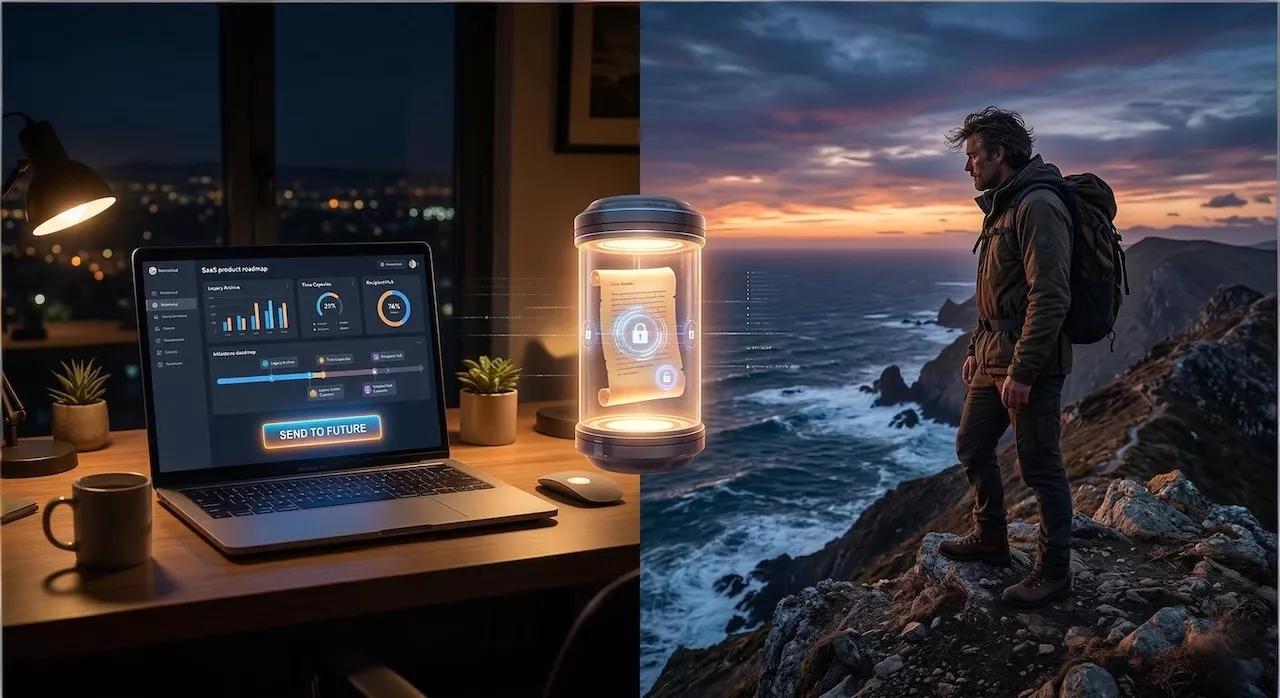
I’m a Product Manager who spends all week optimizing for the "immediate now." But getting lost off the grid on a mountain ridge made me realize I had zero infrastructure for the "forever." Here’s why I stopped worrying about conversion rates for a moment and built EterMail—a secure, tamper-proof digital time capsule for the people I love most.

The Most Radical Letter to Your Future Self Is a Promise to Stay Unfinished
The best letter to your future self isn't a memory—it's a mandate. Learn how writing to the version of you still working with love changes everything.
The Ice Tray at Midnight: On Grief, Domestic Minutiae, and the Quiet Work of Becoming Yourself Again
Why do the smallest habits hurt most after someone leaves? A reflection on grief, domestic minutiae, and the quiet moment healing finally begins.