
The Yogurt Expires on a Tuesday
You don't notice the date at first. You're simply hungry, standing before the open refrigerator, reaching past the wilted kale you keep meaning to compost. Your fingers close around the container—Greek, honey, their brand—and then you see it. The expiration stamp, small and brutal. Three weeks gone.
You stand there longer than the moment warrants. The compressor hums. The kitchen light flickers its fluorescent judgment. And you realize, with the dull clarity of someone waking from anesthesia, that you've been checking this expiration date for months without conscious thought. A ritual of avoidance. A small, domestic haunting.
This is how ghost anniversaries announce themselves: not with flowers or reservations, but with the sudden weight of ordinary objects become archaeological evidence.
What the Calendar Cannot Hold
We are trained to recognize love's official milestones. The first date, the first fight, the anniversary of the anniversary. These are the dates we mark, celebrate, sometimes dread. But the body keeps its own calendar, one written in muscle memory and involuntary flinch, in the pause before answering certain questions, in the songs skipped so quickly they become staccato interruptions to any playlist.
Consider the lease renewal you signed alone. The document arrived by email on a Thursday—an ordinary Thursday, no significance assigned by any system except your own nervous system, which registered the date with the accuracy of a geiger counter clicking near radiation. You had signed leases together before. You had argued about natural light and proximity to laundry facilities, had celebrated with takeout on unfinished floors. Now you checked boxes alone, initials in digital fields, and when the property manager asked if you had any questions, you said no. You said no because the only question was how is this my life now, and you had learned not to ask questions whose answers arrive in the middle of the night.
Or the medical history form, encountered in a fluorescent-lit waiting room, pen hovering above marital status. The options seem suddenly, absurdly insufficient. You are not married. You are not single in the way the form intends. You are something the checkbox cannot capture: formerly entangled, currently excavating. You check "single" and feel the word land like a small betrayal, or perhaps a small liberation—you cannot yet tell which.

The Password as Elegy
There is a particular cruelty to digital memory. The password you change annually, the one that still contains their birthday buried in its alphanumeric architecture. You have known for months that this is unwise, a security risk, a vulnerability. But the changing of it requires acknowledgment. It requires sitting with the keyboard and admitting that this fragment of shared life, this private code between two people who no longer speak, must finally be retired.
You choose something neutral. A random string. The system confirms: Password updated successfully. And you feel, absurdly, as though you have performed a small death. The old password held time. It held the particular angle of their shoulder in morning light, the way they said your name when you were falling asleep. Now it holds nothing. It has been overwritten by entropy and good security practices.
This is the archaeology of contemporary love: we do not bury our dead in earth but in settings menus, in unsubscribe links, in the slow, grinding process of algorithmic forgetting.
The Geography of Avoidance
The vacation spot you now drive around rather than through. The restaurant whose menu you can still recite but whose door you cannot approach. The mutual friend's party, declined with increasing inventiveness until the invitations simply stop arriving.
These are not decisions made in grief's acute phase, when avoidance is expected, even performative. These are the chronic adaptations, the neural pathways worn so deep they become default. You do not think I cannot go there; you simply find yourself on alternate routes, in unfamiliar neighborhoods, building a life in the negative space of what came before.
The body knows before the mind. You will be driving some ordinary Tuesday, some route chosen for efficiency rather than meaning, and suddenly your hands tighten on the wheel. Your stomach performs its familiar drop. And only then, scanning the landscape, do you recognize the trigger: a street sign, a particular quality of light, the angle of a roofline against sky. You have arrived, unwittingly, at the coordinates of a memory your conscious mind had promised to forget.

The Songs We Skip
You claimed it was "ours." This is what couples do, what humans have always done—assign private meaning to public art, make territory of melody. The song played in the car during some significant drive, during the argument that became something else, during the moment you realized you were in love or out of it.
Now the opening notes arrive unbidden through coffee shop speakers, through the algorithm's cruel randomness, through a friend's well-meaning playlist. Your finger moves before thought completes itself. Skip. Next. The interruption so quick you wonder if anyone noticed, if your face revealed the small violence of the gesture.
But here is what no one tells you: the skipping becomes its own ritual. The flinch becomes familiar. And one day, months or years later, you will hear the song and not move. You will let it play. You will discover that the melody has detached from the memory, that the song has become simply itself again—beautiful, perhaps, or dated, or overplayed, but no longer dangerous. This, too, is a ghost anniversary: the anniversary of the day you stopped flinching.
The Milestones of Survival
We misunderstand love's architecture. We build monuments to its beginnings and its formal endings—the proposals, the weddings, the conscious uncouplings, the dramatic final conversations. But love's truest milestones are the moments we survive rather than celebrate. The first night of unbroken sleep. The first genuine laugh at a joke not theirs. The first time you speak their name without the pause that signals old pain.
These are not dates you mark. They are dates that mark you, invisibly, like watermarks on paper that only reveal themselves when held to light. You do not know, in the moment, that you are crossing a threshold. You only know, looking back, that something shifted. That the yogurt finally went in the trash without ceremony. That the password was changed on an ordinary Tuesday, without the anticipated grief. That you drove past the old apartment and did not slow down.
The Letters We Write to Who We Were
There is a particular loneliness to ghost anniversaries: they are witnessed by no one. You cannot call a friend and announce, Today I finally threw away the expired yogurt. The significance would require too much explanation, too much archaeology. The friend would try to comfort you for a loss you are not sure you are still mourning, or celebrate a liberation you are not sure you have achieved.
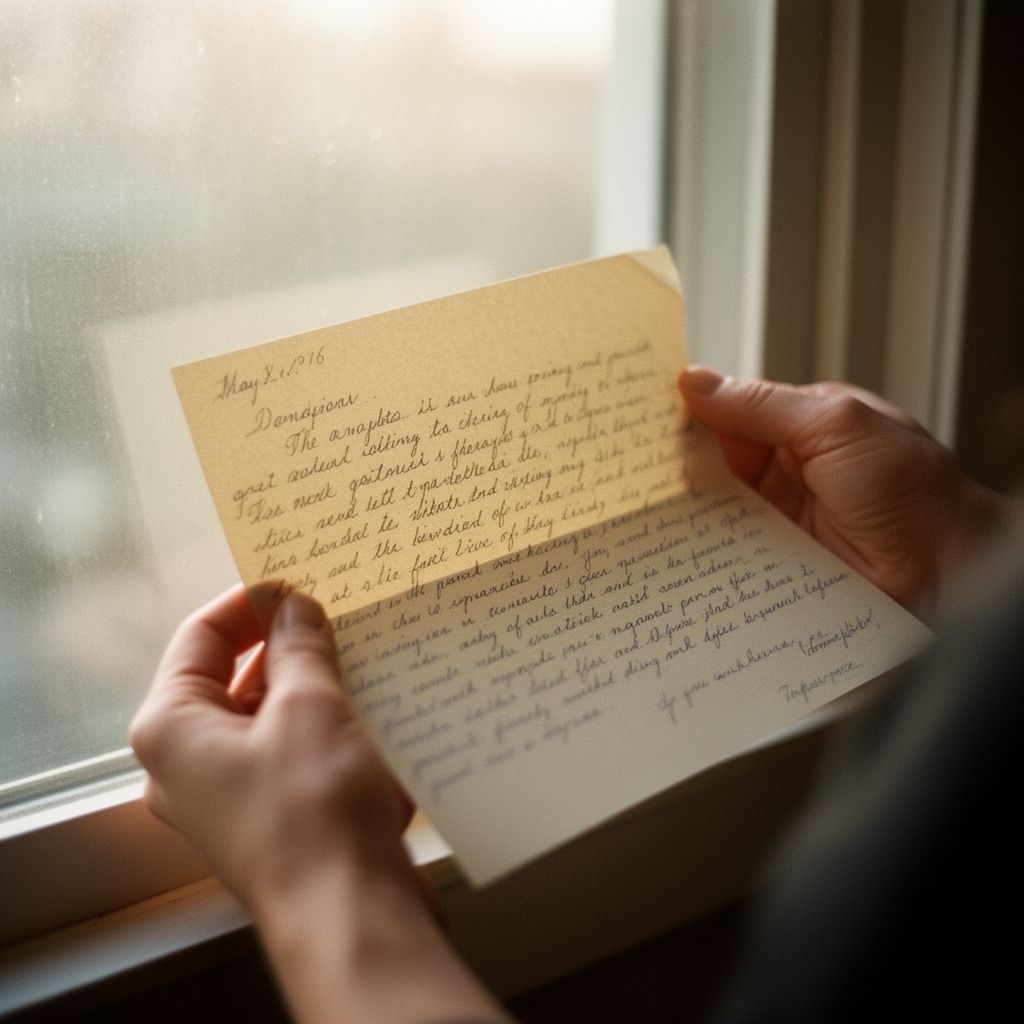
This is where the practice of writing to oneself becomes not self-indulgence but necessary documentation. The letter to your future self, sealed and delayed, creates a witness where none exists. It says: I was here. This mattered. Even if I am the only one who knows, I will not let this pass unrecorded.
I know this loneliness intimately. There were months when I measured my days in Git commits and API responses, building what I believed were permanent structures while my own memories slipped through unarchived. I'd surface from a 2 AM coding session, the screen's glow still burning in my retinas, and realize I'd forgotten to notice the week passing. The extreme solitude of building—those long hours pair-programming with LLMs, mapping architectures until the birds started singing—taught me that digital creation without human anchoring is just sophisticated forgetting. That's why I became obsessed with the boundary between human memory and digital persistence, the wild possibility that we might build systems that honor our fragility rather than accelerate our disappearance.
The best way to fight forgetting isn't taking another screenshot; it's setting an alarm for the future. By using EterMail to set a delivery date 5 years from now, you completely free yourself from the anxiety of the present. You write the letter not because you have answers, but because you trust your future self will still care about the questions. The platform becomes the witness you couldn't find in your contacts list—the one who understands that survival itself deserves commemoration.
The Body Releases What the Mind Cannot
Neuroscience confirms what the heart already knows: trauma and grief are stored somatically. The tightness in your chest when you pass certain intersections. The way your hands know the shape of a phone number you have consciously forgotten. The annual insomnia that arrives without invitation, tied to dates your calendar does not display.
Ghost anniversaries are the body's attempt to process what narrative cannot. They are the physiological echo of emotional events, reverberating through systems that do not respond to reason or will. You cannot think your way through them. You can only endure them, recognize them, and trust that each repetition wears the groove slightly smoother.
This is not healing as we imagine it—not linear, not visible, not celebrated with cards or champagne. This is healing as it actually occurs: in the slow accumulation of ordinary moments survived, in the gradual loosening of the body's grip on what the mind has already released.
What Remains When the Ghosts Depart
You will not always mark these dates. This is the promise hidden inside the haunting: ghost anniversaries expire too. The yogurt will be replaced by your own preferences. The password will become a string you chose deliberately, without residue. The song will play through, and you will notice only that you noticed nothing.
What remains is not absence but texture. The knowledge that you have survived something, that your body has kept faithful watch over experiences your conscious mind might have discarded too quickly. The understanding that love's measure is not only in its presence but in its persistent, cellular memory of having been present.
And perhaps, in the letters you write to who you will become, a record of this archaeology. Not to dwell, but to honor. Not to mourn, but to acknowledge that you were here, in this ordinary moment, and that it mattered enough to mark, enough to send forward through time, enough to trust that your future self will still want to know who you were when the ghosts were still visiting, and you were still learning how to let them go.
What is EterMail?
EterMail is a revolutionary time capsule service that allows you to send messages, photos, and videos to the future (up to 30 years). Seal your memories and thoughts today, and they'll be delivered when the time is right.
Time Capsule
Send messages up to 30 years in the future
Rich Media
Text, photos, and videos supported
Secure & Private
Your memories are safely encrypted
EterMail Team
We're the team behind EterMail, dedicated to helping you preserve and share timeless messages with your loved ones. Our mission is to make it easy to express your love, share your wisdom, and create lasting connections that transcend time.
Related Articles

Why I Built EterMail: A Time Capsule for the People I Love Most
I’m a Product Manager who spends all week optimizing for the "immediate now." But getting lost off the grid on a mountain ridge made me realize I had zero infrastructure for the "forever." Here’s why I stopped worrying about conversion rates for a moment and built EterMail—a secure, tamper-proof digital time capsule for the people I love most.

The Most Radical Letter to Your Future Self Is a Promise to Stay Unfinished
The best letter to your future self isn't a memory—it's a mandate. Learn how writing to the version of you still working with love changes everything.
The Ice Tray at Midnight: On Grief, Domestic Minutiae, and the Quiet Work of Becoming Yourself Again
Why do the smallest habits hurt most after someone leaves? A reflection on grief, domestic minutiae, and the quiet moment healing finally begins.