The Edit That Felt Like a Vow
It happened at 2:47 AM on a Tuesday. I was updating my phone after a software update—one of those mundane digital chores we perform without thought—when I opened my emergency contacts and saw his name still sitting there, third on the list, below my mother and above a college friend I hadn't spoken to in years.
We'd been separated for eight months. The divorce papers were signed. I'd changed the Netflix password and removed our shared calendar. But there he remained, this digital ghost with administrative access to my medical decisions, someone who could theoretically be called if I were unconscious on an operating table.
My thumb hovered. The deletion took less than a second. The weight of it lasted for days.
This is how we build and dismantle intimacy now—not in ceremonies witnessed by crowds, but in solitary acts of data entry. The modern heart leaves a paper trail of permissions granted and revoked, of access codes shared and rescinded. We fall in love through a thousand tiny bureaucracies, and we fall out the same way.

The Architecture of Uncelebrated Milestones
We have no greeting cards for the moments that actually construct commitment. No photographer captures the first time you leave a toothbrush in someone else's bathroom without asking permission first. No anniversary marks the night you stopped texting "made it home safe" because their home had quietly become yours, the distinction too small to notice until it was absolute.
These are the bureaucratic heartbeats of modern love—the administrative acts that, invisible to the outside world, form the true architecture of trust.
Consider the prescription. There is a particular intimacy in knowing someone's medication regimen: the blue pill for mornings, the white one that must be taken with food, the emergency inhaler that lives in the left pocket of their winter coat. You learn this information gradually, through repetition and observation, until one day you realize you could recite it to an EMT without hesitation. You have become, functionally, their next of kin before any legal document confirms it.
Or the WiFi password—the first shared secret of cohabitation, exchanged with casualness that belies its significance. When you give someone your network credentials, you are offering them continuous, invisible access to your private digital atmosphere. They can check the weather from your shower. They can order groceries from your toilet. This is domestic intimacy reduced to its most banal and essential form.
The Weight of Administrative Trust
My friend Elena tells the story of her father's second marriage. After twenty years with her mother, he remarried at sixty-three. The wedding was small, practical, attended by skeptical adult children. But Elena knew the marriage was real—the marriage, not the wedding—when she visited six months later and found her stepmother's name added to all the accounts: the bank, the utilities, the pharmacy where her father picked up his blood pressure medication.
"My mother had never been on those accounts," Elena said. "She handled the house, the children, the emotional labor. He handled the invisible infrastructure. With Margaret, something shifted. He wanted her inside everything."
This is the paradox of modern commitment: it is simultaneously more fragile and more profound than previous generations experienced. We construct it through deliberate, repeated choices rather than social obligation. Each time we add a name to an emergency contact list, we are performing an act of faith. Each time we share a password, we are saying: I trust you with my vulnerability, my resources, my ability to function in the world.
The inverse is equally true. Removing someone from these systems—changing the locks, literal and digital—is not petty or vindictive. It is the necessary architecture of self-preservation. The person who could once silence your morning alarm now cannot enter your building. The transition is brutal in its efficiency.
Time Capsules for the Bureaucratic Heart
What would it mean to honor these invisible milestones? To recognize that the night you memorized her allergy list was as significant as any anniversary?
I've spent enough late nights alone with glowing screens—mapping architectures, wrestling with code until 2 or 3 AM—to understand how digital solitude sharpens your sense of what actually matters. Those hours of "pair programming" with LLMs, building systems that will outlast the session, taught me that the most profound human experiences often leave no immediate trace. The emergency contact update at 2:47 AM. The first time you picked up his prescription without being asked. The quiet Tuesday when you realized you'd stopped keeping separate grocery lists.
These moments deserve witnesses. Not grand declarations of eternal love—though those have their place—but the granular evidence of how intimacy actually accumulates. One customer, a nurse in Minneapolis, sends annual letters to herself on the anniversary of adding her partner to her emergency contacts. "I want to remember," she wrote, "what it felt like to trust someone with my unconscious body. That version of me deserves to be remembered."
The Future of Our Digital Legacies
We are the first generation to leave behind this particular archaeology of love: the shared Spotify accounts, the Amazon household profiles, the Google Maps timeline showing years of synchronized movements. Future historians—if they can access our encrypted, password-protected, terms-of-service-bound records—will understand our relationships through our administrative entanglements.
What will they find? The slow merge of digital lives, documented in timestamped permissions. The abrupt separations, visible in changed passwords and revoked access. The second marriages, reconstructing infrastructure with careful, deliberate steps.
This is why preservation matters. The deliberate capture of these moments—letters to specific future dates, your tenth anniversary, your fiftieth, your child's thirtieth birthday—with instructions for delivery that persist even if you forget you wrote them. A witness to your own evolution, holding evidence of who you were when you built something you couldn't yet see the shape of.
The Ceremony of Maintenance
Perhaps we need new rituals. Not to replace the old ones, but to honor what the old ones cannot capture.
A friend recently described her annual "permissions review" with her partner of twelve years. Every January, they sit together with their phones and laptops and review: Who has access to what? What passwords need updating? Are the emergency contacts still accurate? It sounds clinical, she admitted, but it has become their most intimate annual tradition. "We are saying, explicitly, that we still choose this. That we still want each other inside our systems."
This is commitment stripped of performance: the maintenance of trust through repeated, conscious action.
The emergency contact list is not romantic. The pharmacy pickup is not cinematic. But they are, increasingly, where love lives— in the practical, unglamorous work of allowing another person to matter to your survival.
What We Owe Our Future Selves
I think often of that 2:47 AM deletion. Not with regret—I do not want my ex-husband making medical decisions for me—but with recognition of what it represented. The end of a particular architecture of trust. The beginning of building something new, with different materials, different permissions, different vulnerabilities.
The relationships that last are not those with the most dramatic beginnings, but those with the most sustainable infrastructures. The couples who survive are those who learn to maintain each other's systems—physical, digital, emotional—with patience and precision.
The best way to fight forgetting isn't taking another screenshot; it's setting an alarm for the future. I built EterMail because I know how easily these moments dissolve—how the version of you who built this trust deserves to be remembered, and the version of you who received it deserves to know how it was constructed. By using EterMail to set a delivery date five years from now, you completely free yourself from the anxiety of the present. The platform becomes a time machine for your own emotional archaeology, holding letters that arrive exactly when you need to remember who you were when you dared to build something invisible.
Your emergency contacts will change. Your passwords will evolve. But the record of how you loved—practically, specifically, bureaucratically—can remain. That is the legacy worth preserving.
What is EterMail?
EterMail is a revolutionary time capsule service that allows you to send messages, photos, and videos to the future (up to 30 years). Seal your memories and thoughts today, and they'll be delivered when the time is right.
Time Capsule
Send messages up to 30 years in the future
Rich Media
Text, photos, and videos supported
Secure & Private
Your memories are safely encrypted
EterMail Team
We're the team behind EterMail, dedicated to helping you preserve and share timeless messages with your loved ones. Our mission is to make it easy to express your love, share your wisdom, and create lasting connections that transcend time.
Related Articles
Why I Built EterMail: A Time Capsule for the People I Love Most
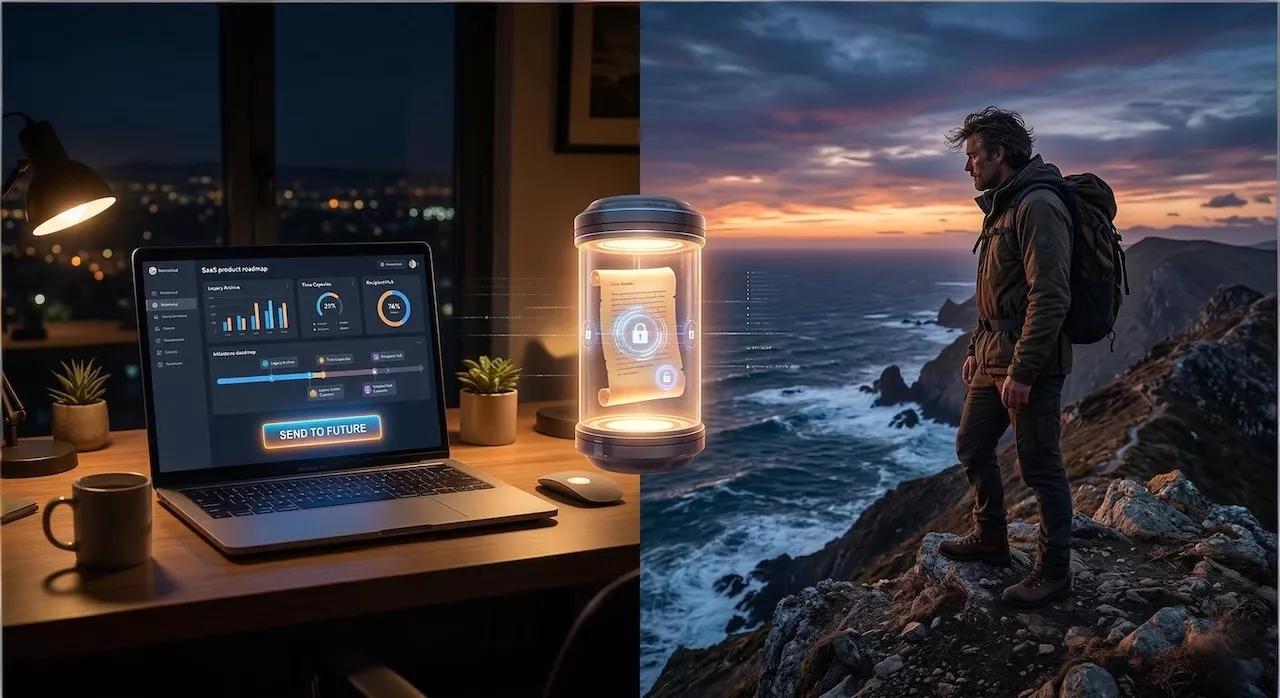
I’m a Product Manager who spends all week optimizing for the "immediate now." But getting lost off the grid on a mountain ridge made me realize I had zero infrastructure for the "forever." Here’s why I stopped worrying about conversion rates for a moment and built EterMail—a secure, tamper-proof digital time capsule for the people I love most.

The Most Radical Letter to Your Future Self Is a Promise to Stay Unfinished
The best letter to your future self isn't a memory—it's a mandate. Learn how writing to the version of you still working with love changes everything.
The Ice Tray at Midnight: On Grief, Domestic Minutiae, and the Quiet Work of Becoming Yourself Again
Why do the smallest habits hurt most after someone leaves? A reflection on grief, domestic minutiae, and the quiet moment healing finally begins.