The Night the Salmon Turned to Ash
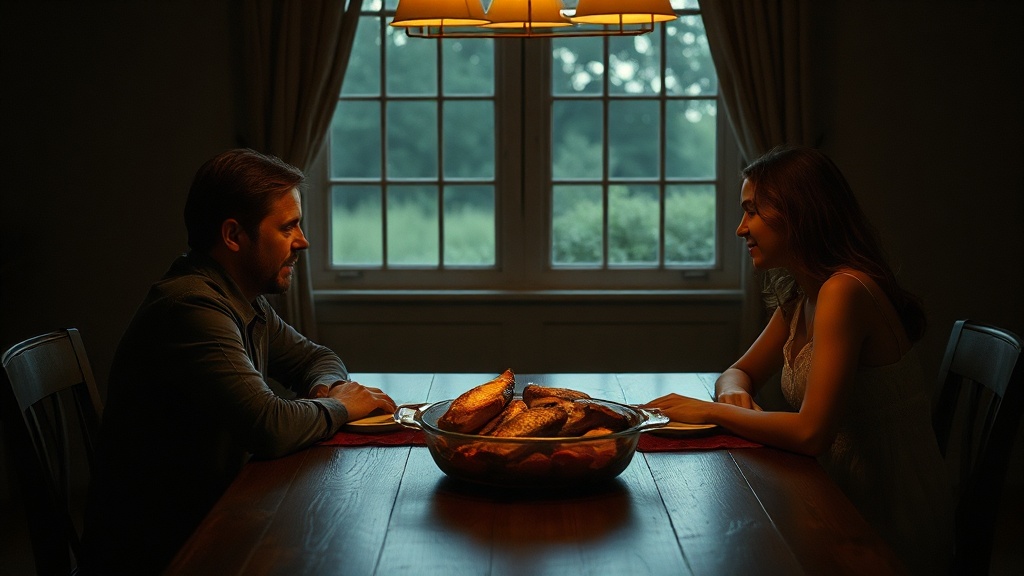
She had been talking about this dinner for seventeen days. The salmon, sourced from a fishmonger forty minutes away. The miso glaze, fermented in her own kitchen. The timing, rehearsed like a symphony in her head. When the smoke alarm finally screamed, I was already in the hallway, watching the orange glow through the oven window.
I knew every move I could make. The baking soda trick. The open windows. The gentle suggestion that we order pizza, that it happens to everyone, that she was exhausted from the week. I had performed this rescue a hundred times before—smoothing the wrinkled presentations, the forgotten birthdays, the credit card statements she avoided opening.
But something held me in that doorway. Not cruelty. Not indifference. Something older and more frightening: the recognition that my rescues had become her dependency, that my love had become a performance she could no longer afford.
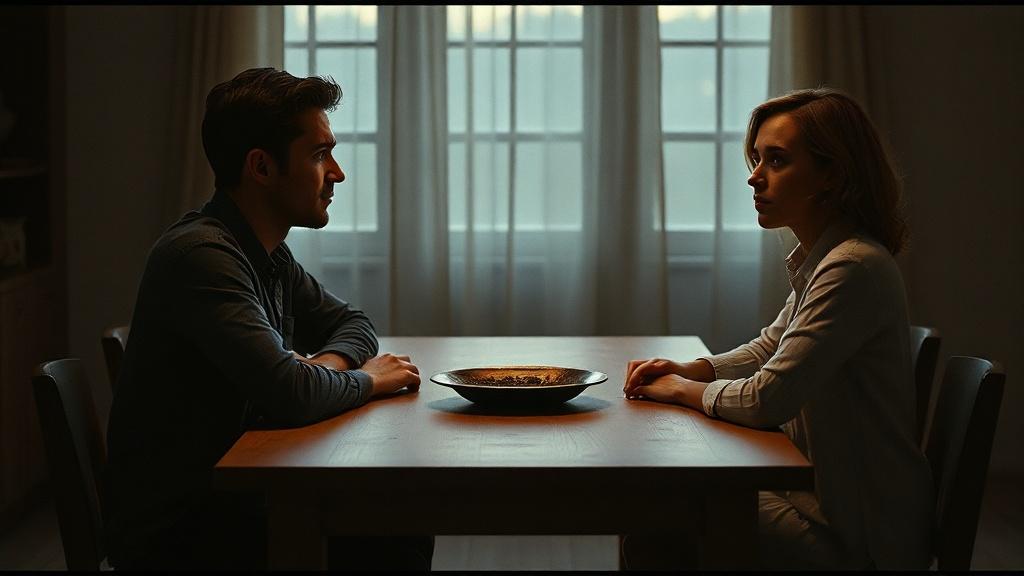
I set the table for two. We ate the charred edges in silence. And in that silence, something new began.
The Architecture of Rescue
Most of us are trained to love as intervention. We learn it from parents who finished our science projects, from friends who covered our shifts, from a culture that equates care with correction. The partner who steps in becomes the hero of a story they never asked to star in.
But there exists a shadow architecture beneath these rescues. Every time I rewrote her cover letter at midnight, I was also writing a quiet contract: you cannot do this without me. Every debt I absorbed, every confrontation I softened, every failure I pre-empted—I was building a museum of her incompetence, curating evidence that she could not survive the world I had made safe for her.
The cruelty of excessive care is that it eventually becomes indistinguishable from control.
Research on adult attachment suggests that partners in "over-functioning" roles often experience a paradoxical loneliness—they are indispensable but never truly known, exhausted by their own generosity yet terrified of what happens if it stops. The rescued partner, meanwhile, lives in a kind of suspended adolescence, their confidence atrophying from disuse.
The Presentation She Forgot
Three months after the salmon, she woke at 6:47 with the particular stillness of someone who has just remembered what they have forgotten. The presentation. The one she had rehearsed aloud in our apartment for two weeks, pacing the hallway with her clicker like a conductor without an orchestra.
I heard her breathing change. Felt her eyes find me in the dark, searching for the offer she had come to expect. I'll call in sick. I'll say it's a family emergency. I'll drive you there and wait in the parking lot with coffee and the backup slides.
I said none of it.
"What should I do?" she asked.
"I don't know," I said. And then, harder: "But you do."
She went. She bombed. She came home with mascara tracks and a story about how the projector failed, how she improvised, how she survived something she had built into catastrophe. The failure was hers. The survival was hers. The strange pride that flickered beneath the shame—that was hers too.
The Weight of Zero
There was a debt, once. Not large by most measures, but large enough that she had never learned to hold it, to feel the specific gravity of owing. I had paid it before she asked. I had paid it before she knew it existed. The relief on her face was immediate; the hollowness that followed took years to name.
Financial therapists call this "financial enmeshment"—the erosion of individual capability through well-intentioned intervention. But the pattern extends beyond money. It is any place where we mistake our anxiety for their emergency, where we cannot tolerate their discomfort and so steal from them the education that discomfort provides.
The safety we refuse is often the only safety that lasts.
This is the mathematics of mature love: sometimes addition requires subtraction. Sometimes protection means exposure. The ground must be felt to be trusted. The fall must be completed to be survived.
Standing in the Doorway
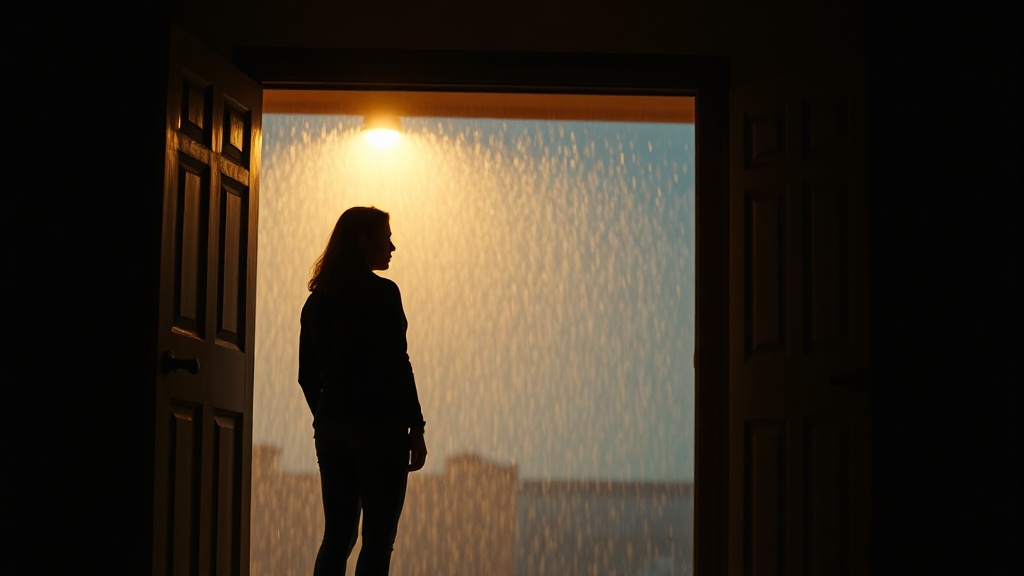
I have come to think of this stance—neither rescuing nor abandoning, present but not intervening—as a kind of radical hospitality. The doorway becomes a threshold where two adults remain distinct. I can see your failure. I can feel your shame. I will not make it mine, and I will not take it from you.
This is excruciating. There is no other word. The body wants to move, to fix, to soften the blow it can already feel gathering force. The mind rehearses arguments: this is unnecessary suffering, I could prevent this, what kind of partner watches and does nothing?
But the doing nothing is not nothing. It is the active construction of trust in another person's resilience. It is the belief that love does not require performance to persist, that our bond is not contingent on my utility or your gratitude.
The philosopher Alasdair MacIntyre writes that we learn what we truly value only through the narratives we construct across time. A relationship built entirely on present-tense rescue has no narrative arc—only an endless series of emergencies, each one forgotten in the urgency of the next. The milestone emerges only when we permit the story to develop, when we allow consequences to accumulate into character.
What Remains When Performance Stops
I used to believe that love was proved through sacrifice. The more I gave up, the more I demonstrated my commitment. This is a young person's calculus, and it is not wrong so much as incomplete. There comes a point where sacrifice becomes theater, where the audience is ourselves, where we are performing devotion for our own approval.
The night of the salmon, after the silence, she said: "You didn't try to fix it."
"No," I agreed.
"I don't know if I like that."
"I don't know if I do either."
We sat with the not-knowing. This, I think now, was the milestone—not the burned dinner, not the forgotten presentation, not any single moment of restraint, but the mutual recognition that our love could contain uncertainty without dissolving. That we could dislike something the other did and remain. That the performance of perfect partnership had finally become too expensive for both of us.

The Letters We Write to Who We Will Become
There is a technology to this kind of love that I did not understand until recently. The practice of witnessing without intervening requires memory—our own, and the memory we help our partners construct of themselves. We are, in part, the archive of their becoming.
I have begun writing letters. Not to her, exactly, though she is present in every one. Letters to the person I am learning to be in this relationship. Letters to the version of her I believe exists beneath the rescue, the version who can hold her own weight, who can trust the ground because she has felt it.
These letters are not interventions. They are not corrections or instructions or promises to save. They are acts of faith in a future we cannot see but are choosing to build, sentence by sentence, silence by silence, burned dinner by burned dinner.
I write these at odd hours—sometimes at my desk until 2 or 3 AM, the same hours I once spent debugging code or arguing with an LLM about architecture patterns. That digital solitude taught me something about conversations across time: the best ones don't demand an immediate answer. The screen glows, the cursor blinks, and I address words to a self I haven't met yet, to a version of us still forming.
The best way to fight forgetting isn't taking another screenshot; it's setting an alarm for the future. By using EterMail to schedule these letters for our tenth anniversary, for moments I cannot yet imagine, I completely free myself from the anxiety of the present. The words arrive when we have forgotten we wrote them—evidence of a love that persisted through its own transformation.
The Courage of Refusal
I want to be clear about what this is not. It is not withholding care when care is needed. It is not weaponized neglect, the passive-aggressive withdrawal of support to teach a lesson. The distinction lives in intention: am I refusing rescue because it serves their growth, or because it serves my resentment? The body knows the difference, even when the mind obscures it.
The courage required is specific and daily. It is the courage to watch someone you love suffer the consequences of their own patterns. The courage to be seen as unhelpful, as cold, as changed. The courage to believe that love is not a feeling that happens to us but a practice we choose, again and again, even when the choice feels like loss.
The truest milestone is not the safety we provide but the safety we refuse. Not because safety is wrong, but because borrowed safety is debt, and debt eventually comes due—with interest, with resentment, with the slow erosion of the very bond it was meant to protect.
What Love Becomes
She burns dinner less often now. Not because I taught her, but because she taught herself—through failure, through the particular education that only consequence provides. She prepares differently. She checks the oven. She has her own rituals, ones I do not know, that belong entirely to her.
Sometimes I still want to step in. The impulse does not disappear; it becomes familiar, like a door you no longer open but still recognize. I stand in the doorway. I watch. I trust that the ground will hold, that she will hold herself, that what remains when performance stops is something we are still learning to name.
Love, perhaps. Or the possibility of it. Or simply two people in a room, eating what has been burned, saying nothing, being enough.
What is EterMail?
EterMail is a revolutionary time capsule service that allows you to send messages, photos, and videos to the future (up to 30 years). Seal your memories and thoughts today, and they'll be delivered when the time is right.
Time Capsule
Send messages up to 30 years in the future
Rich Media
Text, photos, and videos supported
Secure & Private
Your memories are safely encrypted
EterMail Team
We're the team behind EterMail, dedicated to helping you preserve and share timeless messages with your loved ones. Our mission is to make it easy to express your love, share your wisdom, and create lasting connections that transcend time.
Frequently Asked Questions about Love & Milestones
How do you support a partner without enabling dependency?
Why does rescuing your partner hurt the relationship long-term?
What does healthy emotional boundaries look like in marriage?
Related Articles

Why I Built EterMail: A Time Capsule for the People I Love Most
I’m a Product Manager who spends all week optimizing for the "immediate now." But getting lost off the grid on a mountain ridge made me realize I had zero infrastructure for the "forever." Here’s why I stopped worrying about conversion rates for a moment and built EterMail—a secure, tamper-proof digital time capsule for the people I love most.

The Most Radical Letter to Your Future Self Is a Promise to Stay Unfinished
The best letter to your future self isn't a memory—it's a mandate. Learn how writing to the version of you still working with love changes everything.

The Ice Tray at Midnight: On Grief, Domestic Minutiae, and the Quiet Work of Becoming Yourself Again
Why do the smallest habits hurt most after someone leaves? A reflection on grief, domestic minutiae, and the quiet moment healing finally begins.