There is a particular silence that falls between two people who have run out of things to say—not because they have nothing left to share, but because they have forgotten how to wait for the right words. Virginia Woolf, writing in 1925, diagnosed something we still refuse to treat: "we moderns lack love." She did not mean we lack partners, or matches, or the performance of romance. She meant we lack the architecture of attention that love requires—the sustained gaze, the patient accumulation of detail, the willingness to be changed slowly by another person.
A century later, we have engineered the opposite. We swipe through human beings like inventory. We archive our affections in disappearing stories and ephemeral reactions. We have, as the critic Lauren Berlant observed, learned to expect "cruel optimism"—to want from relationships what they cannot give us, then to replace them when the disappointment arrives. The milestone we celebrate most loudly is the beginning: the match, the first date, the relationship status update. We have fewer rituals for the middle, and almost none for the documentation of what happened, what it meant, and who we became.
The Erosion of Sustained Intimacy
Consider what we have lost. Your grandmother's love letters—if you are lucky enough to possess them—were not written in a single sitting. They accumulated across separations, across doubt, across the ordinary days when nothing seemed worth recording. The very act of writing forced a slowness incompatible with our current economy of attention. To compose a letter is to admit that your recipient exists in time, that they will read this tomorrow or next week, that your words must bridge a gap that cannot be closed with a read receipt.
Our technologies promise the opposite: immediacy, abundance, the elimination of distance. Yet something curious happens when intimacy becomes frictionless. We stop noticing. The philosopher Byung-Chul Han argues that "the smooth is the signature of the present," and smoothness erodes texture. We remember less of what costs us nothing. The relationship conducted entirely through platforms designed for engagement metrics becomes, inevitably, a relationship optimized for those metrics—volatile, reactive, constantly restarting rather than deepening.
The Radical Act of Making It Legible
What would it mean to love anachronistically? To choose, deliberately, the slower form?
The handwritten letter that outlasts the app. The voice memo that preserves the particular break in someone's laughter, the way they pause before admitting something true. The photograph printed and annotated rather than posted and forgotten. These are not merely nostalgic gestures. They are technologies of memory in the original sense: techne, craft, the deliberate making of something that will persist.
More radical still: the time capsule. The message composed not for immediate consumption but for a future self who will be grieving, or changed, or in need of evidence that this moment mattered. To write to your future self is to practice a kind of temporal empathy—to imagine who you will become and what you will need to remember. It is to treat your own life as worth archiving, your own loves as worth preserving against the entropy of time.
This is where the milestone shifts. We are trained to mark beginnings and endings—the first date, the engagement, the breakup. But the more consequential moment may be quieter: the decision to make a relationship legible to your future, grieving self. The moment you sit down, deliberately, to record not what happened but what it felt like. What you were afraid of. What you could not yet know.
The Ethics of Digital Legacy
Our grandparents worried about what they would leave behind: property, photographs, perhaps some jewelry. We face a stranger question: what will survive of our interior lives? The vast majority of our digital communications are designed for impermanence. Servers fail. Accounts are deleted. The platforms that host our most intimate exchanges reshape their interfaces, and our histories become unreadable—not through catastrophe, but through neglect.
There is something ethically significant about choosing what to preserve. Not everything deserves immortality. The casual cruelty, the argument composed in haste, the performance of a self you no longer recognize—these might be better forgotten. Curation is a form of care. To select what to save is to practice judgment about what mattered, what changed you, what you want to remain true.

Practicing the Long Now of Love
The psychologist Daniel Kahneman distinguished between the "experiencing self" and the "remembering self"—the one who lives through moments, and the one who constructs the story of what they meant. Modern life increasingly privileges the experiencing self: the constant present of notification and reaction. But the remembering self is the one who grieves, who integrates, who makes meaning across time. To write a letter to your future self is to address that self directly. To say: I am thinking of you. I am making this legible so you will not have to reconstruct it from fragments.
This practice changes the present too. To document love deliberately is to pay attention differently. You notice the specific way your partner stirs their coffee. You register the quality of silence in a room where you both feel safe. You become, in effect, a witness to your own life—not the curated performance of it, but the actual texture of being with another person.
EterMail was built for this specific anachronism. Not to replace the platforms where daily connection happens, but to provide the architecture for what those platforms cannot sustain: the deliberate, time-delayed communication that treats love as worth preserving. A letter to your partner on your tenth anniversary, written now, in the full knowledge of what you do not yet know. A message to your child, composed in the exhaustion of early parenthood, to be received when they are facing their own. A record of this ordinary Tuesday that you suspect, without being able to prove it, contains something essential.
The Milestone We Actually Need
We do not need more celebrations of beginnings. We need rituals for the middle—the long, unglamorous stretch where love is practiced rather than performed. And we need, perhaps most urgently, the milestone of documentation itself: the moment we decide that this matters enough to make it last.
Virginia Woolf's diagnosis still stings because we recognize it. We feel the lack she described—the thinness of connection that costs nothing, the relationships that dissolve because no one built anything to hold them. But the response she implied is not despair. It is craft. The deliberate, skilled making of what will outlast us.
To write a letter that will arrive in five years, or ten, or twenty is to refuse the smoothness of the present. It is to introduce friction, patience, the possibility of being surprised by your own past self. It is to treat love not as a feeling that happens to you, but as a practice you choose to sustain—and to make that choice visible, legible, and lasting.
The most radical act of modern romance may be simply this: the willingness to be slow.
What is EterMail?
EterMail is a revolutionary time capsule service that allows you to send messages, photos, and videos to the future (up to 30 years). Seal your memories and thoughts today, and they'll be delivered when the time is right.
Time Capsule
Send messages up to 30 years in the future
Rich Media
Text, photos, and videos supported
Secure & Private
Your memories are safely encrypted
EterMail Team
We're the team behind EterMail, dedicated to helping you preserve and share timeless messages with your loved ones. Our mission is to make it easy to express your love, share your wisdom, and create lasting connections that transcend time.
Frequently Asked Questions about Love & Milestones
What should I include in a letter to my future self about my relationship?
How do I preserve digital memories without relying on social media platforms?
Why do relationships feel less meaningful in the age of dating apps?
Related Articles
Why I Built EterMail: A Time Capsule for the People I Love Most
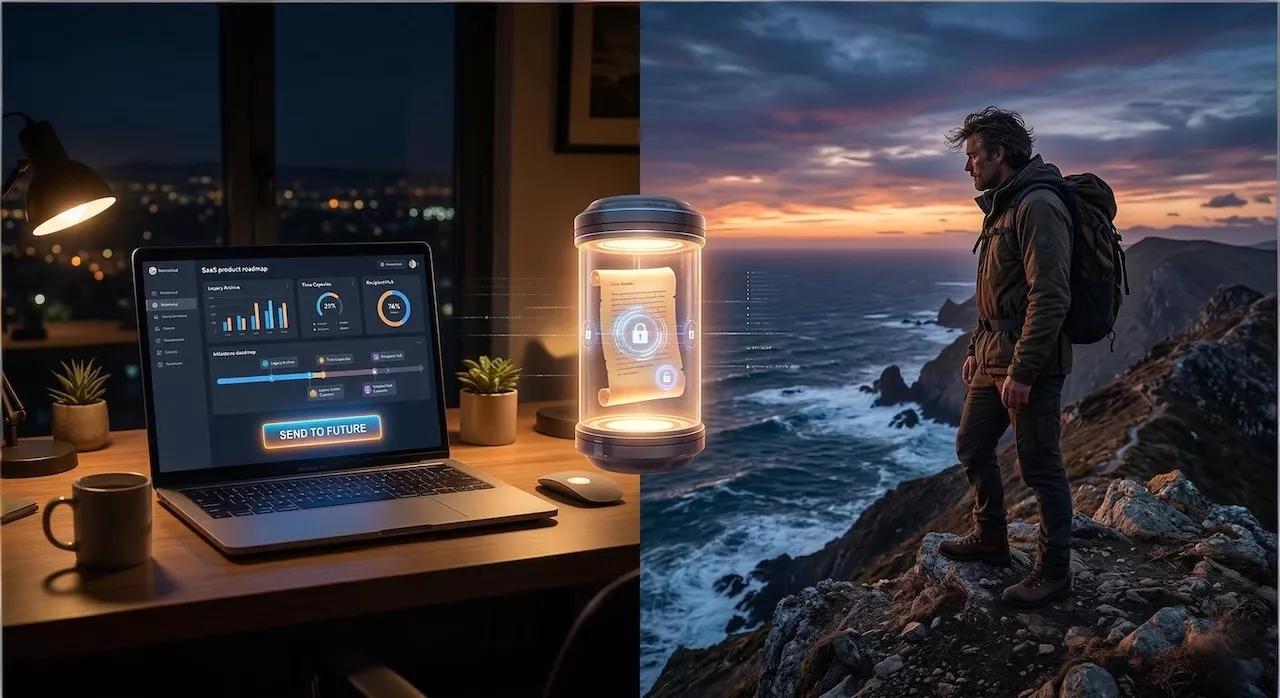
I’m a Product Manager who spends all week optimizing for the "immediate now." But getting lost off the grid on a mountain ridge made me realize I had zero infrastructure for the "forever." Here’s why I stopped worrying about conversion rates for a moment and built EterMail—a secure, tamper-proof digital time capsule for the people I love most.

The Most Radical Letter to Your Future Self Is a Promise to Stay Unfinished
The best letter to your future self isn't a memory—it's a mandate. Learn how writing to the version of you still working with love changes everything.
The Ice Tray at Midnight: On Grief, Domestic Minutiae, and the Quiet Work of Becoming Yourself Again
Why do the smallest habits hurt most after someone leaves? A reflection on grief, domestic minutiae, and the quiet moment healing finally begins.