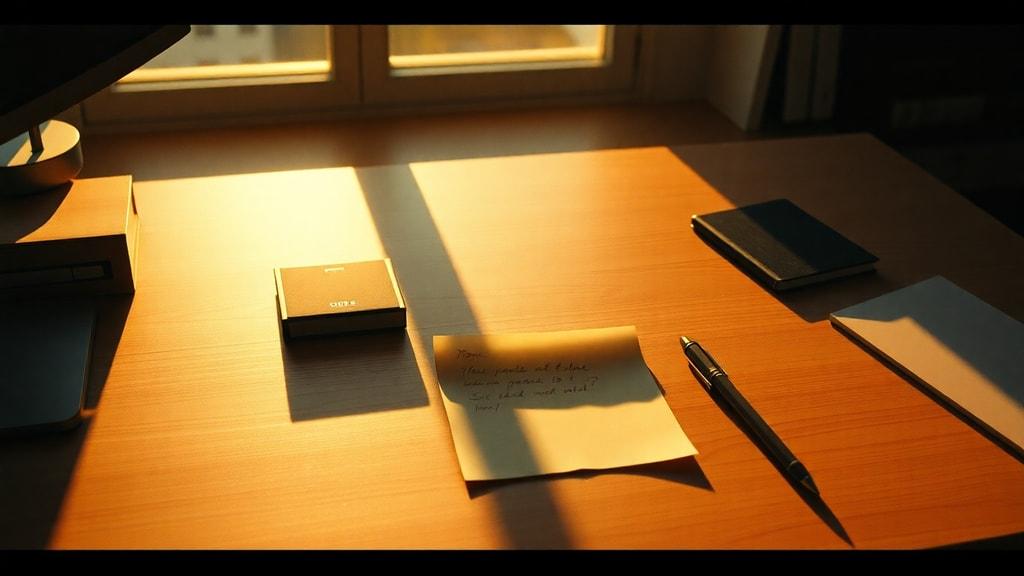
The salary you negotiated at 31. The colleague who believed in you before you believed in yourself. The Thursday afternoon you realized you'd built something that would outlast your tenure. These are the wealth milestones no spreadsheet captures—yet they form the only professional narrative your future self will inherit.
We are spectacularly bad at preserving the meaning of our own labor. We save tax documents for seven years. We archive performance reviews we'll never reread. But the texture of becoming—the fear before the promotion, the strange gratitude for the failure that redirected us, the names of the people who saw our potential when we couldn't—dissolves faster than we expect. Memory is not a faithful archivist. It is a revisionist, constantly rewriting our past to flatter our present or punish it.
This is an invitation to excavate the invisible architecture of your working life before that revisionism takes hold, and to ask what the person you haven't become yet deserves to remember about who you were when it mattered.
The Wealth That Doesn't Appear on Statements
Wealth, in the conventional accounting, is a number. It lives in accounts we check too often or avoid checking entirely. But there is a parallel currency we accumulate across decades of work: the accumulated evidence of our own evolution. The first time you spoke up in a meeting and changed the direction of a project. The client who became a friend. The skill you taught yourself at 2 AM because no one else could, and the strange pride of that solitude.
I know that particular solitude well. I've spent countless nights exactly like that—alone with a glowing screen, pair-programming with LLMs until 2 or 3 AM, mapping out architectures that felt like constructing bridges between worlds. That extreme digital solitude taught me something about what we actually preserve from our working lives. Not the code, not the deployments—but the who we were in those hours, the person who believed this mattered enough to stay awake for it.
These moments are not sentimental indulgences. They are data points in the longitudinal study of your own competence and character. Without them, you risk what psychologists call "narrative foreclosure"—the premature conclusion that your story is finished, that the best chapters have already been written. The antidote is not ambition but documentation: the deliberate, structured preservation of meaning as it happens, before the urgency of the next quarter erases it.

The Milestones We Misidentify
Our culture offers a ready-made script for career milestones: the promotion, the funding round, the title change, the liquidity event. These are visible, legible, shareable. But they are not necessarily the moments that formed us. Often, the true inflection points arrive unannounced and uncelebrated.
Consider the anti-milestones: the project that failed and taught you what you would not compromise. The period of stagnation that forced you to develop an internal compass. The colleague who betrayed your trust, and the subsequent decision to remain trustworthy anyway. These are not setbacks in a linear narrative. They are the dense matter of professional identity, the moments where you discovered what you valued more than advancement.
Research on autobiographical memory suggests that we remember our lives not as continuous narratives but as peak moments and endings. The problem is that we rarely choose which peaks to preserve. The urgent email we sent at midnight eclipses the patient mentorship we offered Tuesday morning. The quarterly target met obscures the ethical line we refused to cross. Without intentional curation, our remembered careers become distorted highlight reels, stripped of the ambiguity that actually shaped us.
The Letter Your Future Self Needs
What would it mean to write, today, to the person you will be at your next major transition? Not a goal list. Not a strategic plan. A letter of witness: an account of who you are in this particular season of your working life, written with the understanding that this version of you will not survive intact.
This is where the practice of future-letter writing becomes something more than self-help exercise. It becomes an act of professional integrity—a refusal to let your past self be entirely consumed by your present one. The letter might include:
- What you are currently afraid of, named specifically, without the armor of retrospective wisdom
- What you are proud of that no one else knows about
- The names of people who have helped you, with the particularity of how they helped
- What you are currently wrong about, acknowledged with as much grace as you can muster
- The specific texture of your days: the commute, the coffee shop, the recurring worry, the small victory
These details feel trivial in the moment. They are not. They are the primary source material of your own life, the evidence that will allow your future self to reconstruct not just what you did, but who you were while doing it.

The Compound Interest of Documented Wisdom
There is a financial concept that applies strangely well to memory: compound interest. Small, regular deposits grow disproportionately over time. The same is true of documented reflection. A single letter to your future self is a gesture. A series of them, written at career inflection points—after a promotion, during a plateau, on the verge of a leap—becomes a longitudinal record of your own decision-making under uncertainty.
This record has practical value. It reveals patterns in your risk tolerance, your recurring blind spots, your evolving definition of success. It inoculates against the hindsight bias that makes every past decision seem inevitable. And it offers something rarer: evidence that you have survived uncertainty before, that the person you were at 28 navigated ambiguity with resources you have since forgotten possessing.
The wealthiest professionals I know are not those with the most impressive titles. They are those who have preserved the continuity of their own narrative, who can trace the thread from who they were to who they are without relying on memory's unreliable editing.
Writing to the Person You Haven't Become
The most difficult letters are not to your future self but to the future versions of people you currently work with—the colleague who will outlast you at this company, the client whose project will conclude after you leave, the employee you are currently mentoring who will one day lead without you. These are letters of professional legacy in the truest sense: not what you built, but what you witnessed and affirmed in others.
Consider writing to:
- The colleague who believed in you before you believed in yourself, thanking them with the specificity they may not have received in the moment
- The person currently struggling in a role you once held, offering not advice but testimony: I was here, and this is what it was like
- Your own future team, if you lead one now, acknowledging what you currently do not know and hope to learn
These letters are not performance reviews. They are acts of temporal hospitality—extending care across the distance between who you are and who others will become.

The Architecture of a Working Life
Your career is not a ladder. It is not a path. It is an architecture—a structure you inhabit and modify across decades, with load-bearing walls you did not know you were constructing and doorways you opened without understanding where they led. The salary negotiation at 31 mattered not because of the number but because it was the moment you decided your value was worth arguing for. The colleague who believed in you mattered because their belief became, temporarily, your own.
I've spent years building products with hardcore tech stacks, wrestling with massive codebases and cold server deployments, and what I've learned is that all of it is meaningless unless it serves something genuinely human. The weekend I spend hiking steep trails or surfing—feeling the raw reality of wind and waves, the unrepeatable present moment—teaches me more about what matters than any architecture diagram. Technology must strip away illusions, not create them. A letter written at 2 AM and delivered years later carries more weight than any notification.
This is exactly why I obsessed over end-to-end encryption and extreme server redundancy when building EterMail. Because I know that a letter written to the future needs to be guarded even more fiercely than a bank password. The continuity of your professional narrative deserves that protection.
What will your future self remember about who you were when it mattered? The answer depends, entirely, on what you choose to preserve today.
What is EterMail?
EterMail is a revolutionary time capsule service that allows you to send messages, photos, and videos to the future (up to 30 years). Seal your memories and thoughts today, and they'll be delivered when the time is right.
Time Capsule
Send messages up to 30 years in the future
Rich Media
Text, photos, and videos supported
Secure & Private
Your memories are safely encrypted
EterMail Team
We're the team behind EterMail, dedicated to helping you preserve and share timeless messages with your loved ones. Our mission is to make it easy to express your love, share your wisdom, and create lasting connections that transcend time.
Frequently Asked Questions about Career & Wealth Milestones
What should I include in a career milestone letter to my future self?
How do I preserve professional memories before they fade?
Why do we misremember our own career achievements?
Related Articles

Why I Built EterMail: A Time Capsule for the People I Love Most
I’m a Product Manager who spends all week optimizing for the "immediate now." But getting lost off the grid on a mountain ridge made me realize I had zero infrastructure for the "forever." Here’s why I stopped worrying about conversion rates for a moment and built EterMail—a secure, tamper-proof digital time capsule for the people I love most.

The Morning You Stop Checking the Obituaries: On the Quiet Geography of Outliving Your Grief
What happens when you finally stop searching for proof they're gone? A meditation on the strange, ordinary moment grief loosens its grip without asking permission.

The Weight of Unsent Words: How Digital Mindfulness Can Save Us from the Infinite Present
We archive everything and remember nothing. Digital mindfulness means writing the letter now—to the person you still have, while you have them.