There is a photograph of my mother I have never seen. She described it once, laughing, how she stood on a Barcelona balcony at twenty-three, hair wild from the Mediterranean, absolutely certain she would never be ordinary. The image was lost in a move, a box left behind, and her telling of it became more luminous than any print could have been. I carry her youth in the shape of her words, not pixels. I am free to imagine the exact tilt of her chin, the particular blue of that sky. She gave me the gift of partial memory, and in that gap, I found room to love her more completely.
We have built systems that refuse such gaps. Our clouds swell with every version of every self we have been—angry emails sent at 2 AM, the search history of our despair, photographs of bodies we have outgrown, voice notes from arguments we would have otherwise forgotten by morning. The digital legacy we are assembling is unprecedented in human history: a record of consciousness without the mercy of decay. And we have not stopped to ask whether those who inherit this archive will be enriched by its completeness or crushed beneath its weight.
The Forgetting That Makes Us Human
Oliver Sacks, in his later writings on memory and creativity, proposed something quietly radical: that forgetting is not a failure of the mind but an active, necessary function. The brain edits. It softens the edges of grief, blurs the specifics of humiliation, allows the narrative of a life to cohere through selective emphasis. We are not the sum of every moment we have lived. We are the story we have managed to tell about those moments, and stories require omission.
A memory unedited by time is not a gift. It is a burden.
Consider what we ask of our survivors. A daughter opens her father's laptop and finds not the man who read her bedtime stories but the man who searched "is this a heart attack" at 3:47 AM on a Tuesday in March. A widow discovers the draft emails never sent, the versions of her husband that existed in frustration and loneliness, preserved with the same fidelity as his wedding vows. The digital archive knows no proportion, no narrative arc. It simply is, in all its raw simultaneity.
The Paradox of Preservation
We preserve because we love. This impulse is ancient and honorable. But digital preservation operates under a false premise: that more complete preservation equals more complete love. The family photograph album, curated over decades, was never complete. It was chosen. Someone decided which moments deserved the weight of memory, which could be released. That act of choosing was itself an act of care, a form of emotional editing that shaped what the family would collectively remember.
Our current systems remove the curator. They preserve the argument and the reconciliation with equal indifference. They save the photograph where no one is looking at the camera, where the tension is visible in shoulders and jawlines, alongside the one where everyone is laughing. The algorithm has no sense of which version of us should endure, which might be better allowed to dissolve.
The most loving thing you might leave behind is not everything, but the right things.
This requires a different kind of labor than we have been trained to perform. It asks us to become editors of our own existence, to make judgments about what deserves to survive us. It asks us to believe that our survivors do not need our completeness—that they might be better served by our curation, by the generosity of absence that makes room for their own imagination.
The Imagination of the Bereaved
Psychologists who study grief have long noted the productive work of what they term "continuing bonds"—the ongoing relationship the living maintain with the dead, constructed through memory, ritual, and imagination. These bonds are not static. They evolve. The deceased becomes, in some measure, who the survivor needs them to be. A mother becomes wiser in retrospect. A friend becomes more forgiving. This is not delusion. It is the necessary poetry of mourning, the mind's capacity to complete what death interrupted.
A total digital record forecloses this poetry. It fixes the dead in the amber of their worst and most mundane moments. It denies the survivor the collaborative act of memory-making, the gentle negotiation between what was and what might have been. When every text message is searchable, there is no space for the conversation you wish you had had.

Curating as an Act of Love
What would it mean to curate our digital legacy with the same intention we once brought to physical ones? To ask, of each preserved fragment: does this help someone know me, or does it merely expose me? To recognize that the self we show our survivors need not be the self we were at every moment, but the self we aspired to become, the through-line of values and loves that made a life coherent?
This is not deception. It is narrative. Every autobiography is edited. Every eulogy selects. We have always constructed the stories of our dead, and in that construction found meaning. The digital age simply confronts us with the raw material more starkly, demands that we make choices we once made by default.
A curated absence is not erasure. It is an invitation.
When we leave space in our legacy, we invite those who survive us to meet us halfway. To fill the gaps with their own understanding, their own need, their own love. The photograph my mother lost became more powerful because I completed it. Her incomplete preservation allowed me a role in her memory that total recall would have denied me.
The Technology of Intentional Memory
I spend too many nights alone with screens, pair-programming with LLMs until 2 or 3 AM, chasing architectures that dissolve at dawn. That extreme digital solitude taught me something paradoxical: the most human connections happen not in real-time feeds, but across distance and delay. A letter written to a future self, to a child not yet born, to a spouse decades hence, operates by different rules than the accidental accumulation of digital debris. It is chosen. It is shaped by the awareness of its recipient, by the emotional intelligence of distance and time.
The best way to fight forgetting isn't taking another screenshot; it's setting an alarm for the future. By using EterMail to set a delivery date 5 years from now, you completely free yourself from the anxiety of the present. You compose in the quiet of who you are now, for the person you will become—or for someone you love who does not yet know they will need your words.
The Legacy We Choose to Leave
We are the first generation to confront this particular problem: not too little memory, but too much. Not the fragility of records, but their indestructibility. The question before us is whether we will passively allow our digital exhaust to define us, or whether we will actively shape the narrative of our survival.
The answer lies not in technology alone, but in the recovery of older practices: the deliberate composition, the considered audience, the acceptance that we are not obliged to preserve everything, that our survivors are not entitled to our every moment, that love can express itself through what we choose to release as much as what we choose to keep.
My mother's lost photograph taught me this. She did not fail to preserve her youth. She succeeded in preserving something more valuable: the capacity for me to imagine her joy, to participate in her memory, to love her not as a fixed image but as a living possibility. In the space between what she told and what I imagined, we made something together that no archive could have contained.
The digital legacy worth leaving is not the one that remembers everything. It is the one that remembers enough, and forgets enough, to remain human.
What is EterMail?
EterMail is a revolutionary time capsule service that allows you to send messages, photos, and videos to the future (up to 30 years). Seal your memories and thoughts today, and they'll be delivered when the time is right.
Time Capsule
Send messages up to 30 years in the future
Rich Media
Text, photos, and videos supported
Secure & Private
Your memories are safely encrypted
EterMail Team
We're the team behind EterMail, dedicated to helping you preserve and share timeless messages with your loved ones. Our mission is to make it easy to express your love, share your wisdom, and create lasting connections that transcend time.
Frequently Asked Questions about Digital Legacy
What should I include in a digital legacy for my family?
How do I protect my family's privacy when planning my digital legacy?
Is it better to leave everything digital for my family or to curate what they receive?
Related Articles
The Farthest Message: What the Artemis Astronauts Taught Us About Leaving Traces We Cannot Control
When Artemis II carried humanity's farthest data from the Moon, it revealed something profound: our most lasting legacy lives in what we almost deleted.
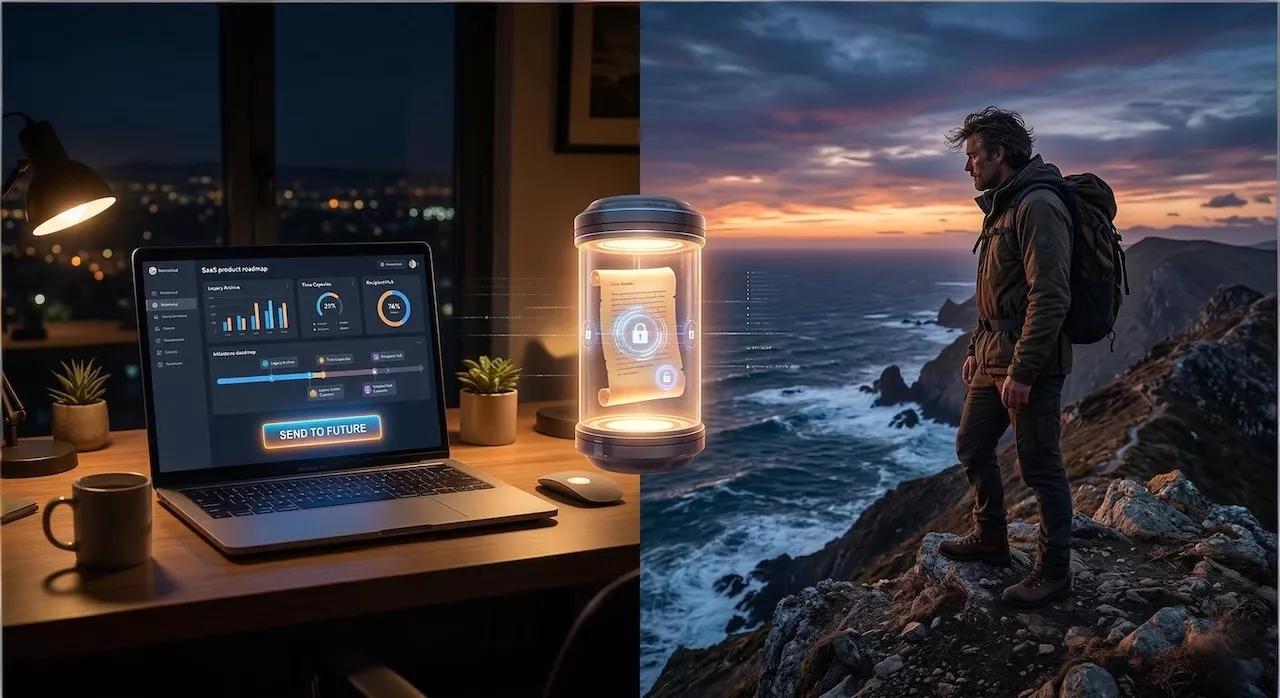
Why I Built EterMail: A Time Capsule for the People I Love Most
I’m a Product Manager who spends all week optimizing for the "immediate now." But getting lost off the grid on a mountain ridge made me realize I had zero infrastructure for the "forever." Here’s why I stopped worrying about conversion rates for a moment and built EterMail—a secure, tamper-proof digital time capsule for the people I love most.

The Most Radical Letter to Your Future Self Is a Promise to Stay Unfinished
The best letter to your future self isn't a memory—it's a mandate. Learn how writing to the version of you still working with love changes everything.