The Unfinished Game
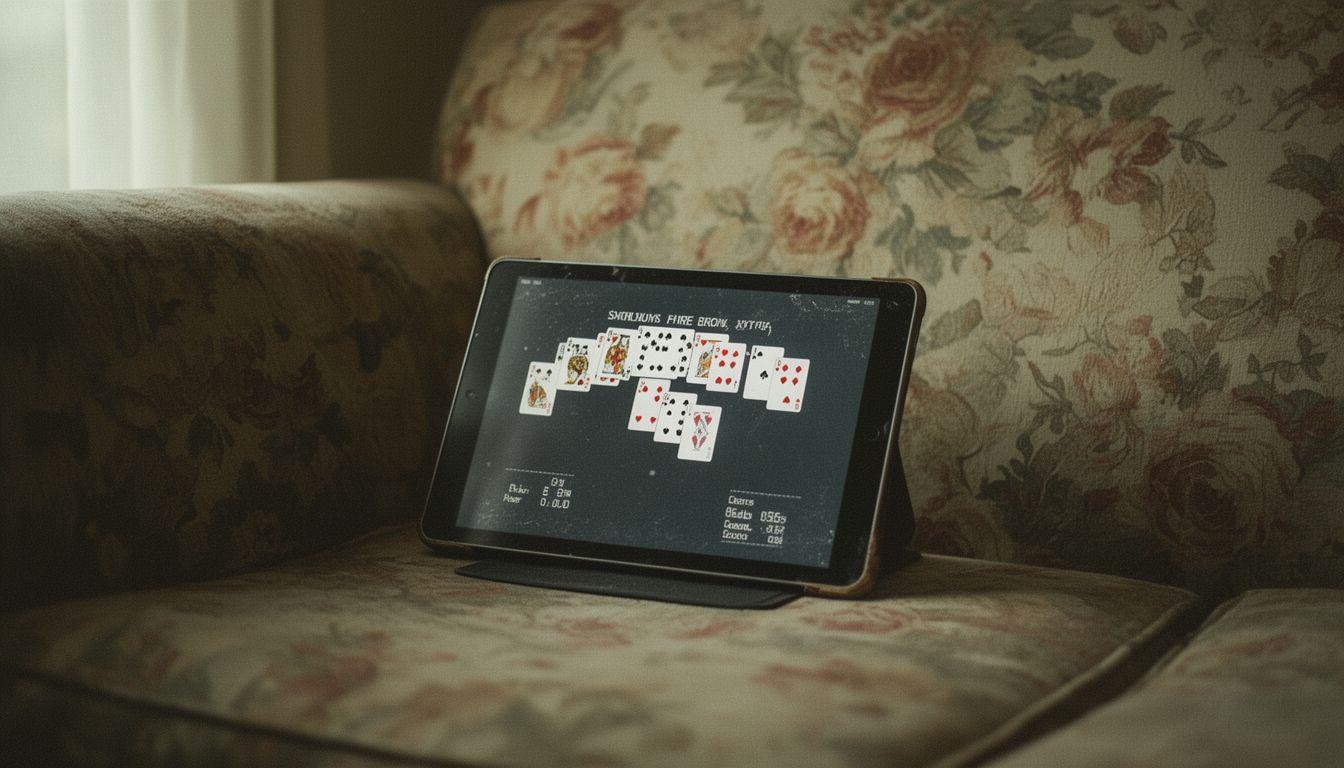
You find it three weeks after the funeral, buried in a drawer beneath expired coupons and reading glasses she never wore. The tablet is heavier than you remember, its case cracked at the corner from a fall she never mentioned. You charge it out of obligation, expecting photo albums, maybe a half-finished email to the pharmacy. Instead, you open her solitaire app.
4,327 games. Zero wins.
The statistic hangs there, obscene in its specificity. You scroll through months of daily entries—March 14th, 23 games; June 3rd, 41 games; the Tuesday before she died, 67 games in a single afternoon. Each loss logged with algorithmic indifference. Each session a small, private act of endurance.
You tap New Game. The cards deal. You lose in forty-three seconds. The app offers to let you continue. You decline. You lose again. The third time, you notice your thumb has found her rhythm—quick drag, hesitant pause, the same frustrated swipe she must have made ten thousand times.

The Archaeology of Absence
We prepare for digital legacy as if it were curation. Backup the photos. Export the contacts. Preserve the important documents—the tax returns, the property deeds, the password list she kept in a note titled "DO NOT DELETE." We imagine inheritance as a transfer of assets, a clean handoff of meaning.
But meaning lives in the margins. The 4,327 games she never won. The podcast episode she replayed seventeen times during insomnia. The GPS history showing she drove to your childhood home twice in her final month, never getting out of the car.
These are not content. They are behavioral fossils—the residue of presence, the digital equivalent of finding a worn path through grass where someone walked the same route daily for years. No photograph captures this. No video records the particular loneliness of a solitaire game played at 3 AM, the screen's blue light the only witness to her wakefulness.
The grief catches you unexpectedly. Not in the photo albums you expected, but here: in her high score that will never improve, in the daily streak frozen at its final number, in the app that will never know its player has died.
The Paradox of Mindful Mindlessness
There is a particular quality to the digital rituals we perform without thought. The infinite scroll. The refresh. The game played not for victory but for occupation—something for the hands while the mind wanders through worry, through memory, through the quiet endurance of ordinary pain.
Researchers call this "habitual media use"—the automatic, almost unconscious engagement with technology that fills the interstitial moments of our days. We dismiss it as waste. Time we should have spent better. But these rituals are also self-soothing technologies, private methods of regulating emotion that we develop without language or intention.
Your grandmother never told you about the solitaire. You knew about the bridge club, the church choir, the neighbor she called every Sunday. These were her presentable habits, the ones that composed a coherent narrative of who she was. The 4,327 games existed outside narrative. They were hers alone—not for performance, not for memory, not for anyone's witness.
Until now. Until you.

The Ethics of Inherited Data
You face a decision that no inheritance law addresses. The app offers to reset her statistics. You could start fresh, claim the account as your own, perhaps finally win the games she couldn't. Or you could leave it—the 4,327 losses preserved in digital amber, her final score unbroken, her daily streak ended only by mortality itself.
There is something violent in either choice. To continue playing is to overwrite her presence with your own, to treat her most private ritual as raw material for your entertainment. To abandon the app is to let her final months dissolve into platform deletion policies, her thousands of games reduced to a single line in a terms-of-service agreement she never read.
You research. The app stores data locally. If you never update the tablet, never connect it to new networks, her 4,327 games might persist for years—longer than the photos you carefully backed up to cloud services that will restructure, rebrand, or disappear entirely. Her mindless ritual turns out to be more durable than her intentional archives.
This is the hidden architecture of digital legacy: our most ephemeral behaviors often outlast our most deliberate preservation. The photo album we curated with care gets corrupted. The solitaire statistics we never thought to save persist in device memory, waiting.
The New Heirlooms
We need new language for what we inherit. Not assets. Not data. Something closer to presence patterns—the unique signatures of how someone moved through digital space, the rhythms of their attention, the contours of their solitude.
Your grandmother's solitaire is not about solitaire. It is about the particular way she faced time when time became too much to bear. The refusal to win—was that stubbornness? Philosophy? The simple inability to see patterns she once would have recognized instantly? Each game a small act of persistence without purpose, of continuing without hope of conclusion.
You realize you want to leave something similar. Not the curated self you present to others, but the unguarded self that exists in private digital spaces. The playlist you listen to when you can't sleep. The notes app where you draft sentences you never send. The search history that reveals your fears more honestly than any confession.
But how? These fragments scatter across platforms with their own imperatives, their own deletion schedules, their own definitions of what counts as valuable. Your solitaire statistics belong to a corporation that will outlive you only if it remains profitable. Your presence patterns are not yours to bequeath.

The Possibility of Intentional Fragments
I spent years building things that disappeared. E-commerce platforms that pivoted. Game servers that shut down. Code I wrote at 2 AM, convinced I was constructing something permanent, now exists only in deprecated repositories I can't access. The digital world teaches you that everything built can be unbuilt—that permanence is a fiction we tell ourselves while the platforms rewrite their terms of service beneath our feet.
But this is exactly why I obsessed over end-to-end encryption and extreme server redundancy when building EterMail. Because I know that a letter written to the future needs to be guarded even more fiercely than a bank password. The solitaire games will vanish when the tablet dies. The photos will compress and degrade in cloud storage. But words you choose to send through time—those can remain exactly as you wrote them, delivered when you intended, to whom you intended, immune to the corporate entropy that swallows everything else.
Time-capsuled messages are not the grand pronouncements we imagine our legacy demands, but small, specific communications released to future selves or chosen recipients at moments we will not witness. A letter to your daughter on her thirtieth birthday, written now while she is seven and you are still learning who she will become. A voice memo to your future self, scheduled to arrive on a date you have arbitrarily determined will matter. A collection of your own unimportant digital rituals—the playlist, the failed recipes, the draft emails never sent—preserved not as content but as evidence of being alive in a particular way.
These are not replacements for the accidental archives we leave behind. They are complements—intentional fragments that acknowledge what we have learned from inheriting the unintentional ones. Your grandmother's solitaire taught you that legacy is not in the victories but in the showing up. Not in the curated album but in the 4,327 small refusals to stop.
The Game Continues
You do not reset her statistics. You do not continue her streak. Instead, you screenshot the final numbers—4,327 games, 0 wins, last played: the morning she died—and save it where you save things that matter without knowing why.
Then you write. Not about her, exactly. About the particular loneliness of digital rituals, the way we leave traces we never intended, the strange intimacy of inheriting someone's mindless persistence. You write to your own future self, scheduling delivery for a date you hope to reach, a moment when you will have forgotten this specific grief and need to remember that presence takes many forms.
The tablet goes back in the drawer. The app will remain, her statistics frozen, until the battery finally dies or the operating system becomes obsolete. You have made your choice: to let her remain unfinished, unimproved, her 4,327 games a testament to nothing except that she was here, she persisted, she never won but she never stopped playing.
This is the legacy we actually leave. Not the wins. The showing up. The thousands of small, private acts of continuing that no one was meant to see, but that someone, someday, will inherit and recognize as love.
What is EterMail?
EterMail is a revolutionary time capsule service that allows you to send messages, photos, and videos to the future (up to 30 years). Seal your memories and thoughts today, and they'll be delivered when the time is right.
Time Capsule
Send messages up to 30 years in the future
Rich Media
Text, photos, and videos supported
Secure & Private
Your memories are safely encrypted
EterMail Team
We're the team behind EterMail, dedicated to helping you preserve and share timeless messages with your loved ones. Our mission is to make it easy to express your love, share your wisdom, and create lasting connections that transcend time.
Frequently Asked Questions about Digital Legacy
What counts as a digital legacy beyond photos and documents?
How do I ethically handle a deceased loved one's private digital rituals?
Can I intentionally preserve my own 'unimportant' digital habits for future family?
Related Articles

The Marginalia of the Dead: How My Aunt's Kindle Highlights Became Her Secret Autobiography
What do our digital traces reveal after we're gone? One woman discovered her aunt's private becoming through 1,847 Kindle highlights and a single word: yes.
The Last Text on Her Desktop: How Digital Artifacts Become Sacred Monuments to Love
A father resets his late daughter's password and discovers her desktop wallpaper: his last text. The story of how unintended digital artifacts become our most precious monuments.

The 847 Searches She Left Behind: How Digital Footprints Reveal Love's Invisible Labor
What if your digital footprint revealed the love you never spoke? Discover how browser history, late-night searches, and forgotten files become our most intimate legacy.