The Moment You Stop Being a Person and Become Data
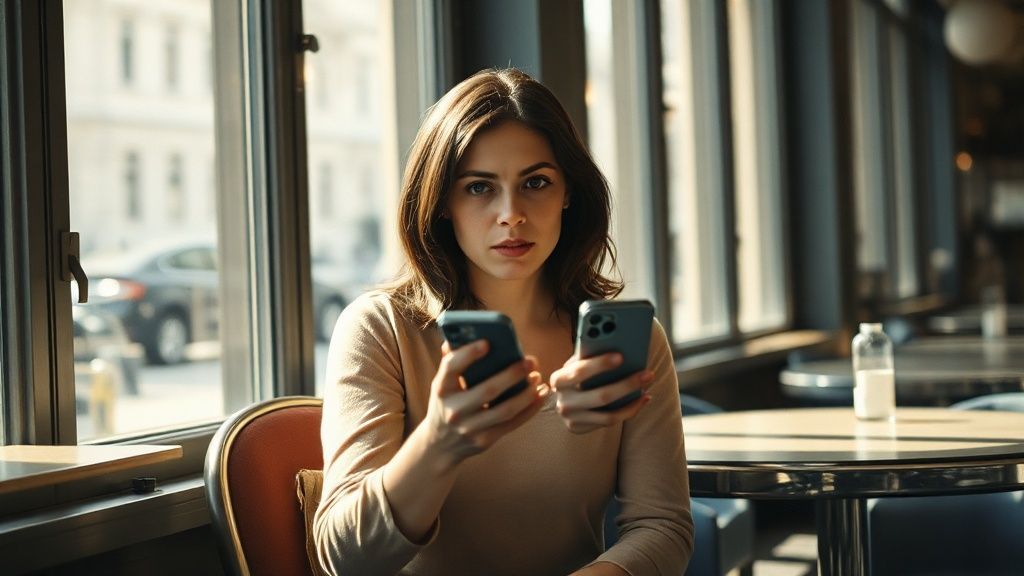
She sat in a café in Berlin, phone in hand, staring at a screen that asked for her face. Not a password. Not a fingerprint she'd already surrendered years ago. Her face. To read an article. To prove she was old enough, human enough, real enough.
The café hummed with conversation, with the clatter of porcelain, with lives being lived in analog warmth. But her screen demanded something colder: irrefutable proof of existence. And in that moment, she understood something that Europe's regulators are only beginning to grapple with—every system designed to verify your humanity becomes another ledger of your existence. Another file. Another prediction of who you might become.
This is the paradox of our age: we build walls to protect what matters, then watch as the mortar hardens around our own wrists.
The Verification Trap: When Protection Becomes Surveillance
Europe's scramble for "privacy-preserving" age verification has exposed a fault line we rarely acknowledge. Lawmakers want to protect children from harmful content. Platforms want to comply without hemorrhaging users. And technology vendors arrive with solutions that promise the impossible: proving who you are without recording what you've proven.
But here's what the white papers won't say: verification is never neutral. Every time you demonstrate your humanity to a machine, you teach it something about human patterns. Your face becomes training data. Your voice, a biometric signature. Your behavioral tics—how you hold your phone, how long you hesitate, how your eyes move—a forensic map of your consciousness.
The UK's Age Appropriate Design Code. France's AVIA law. Germany's ongoing debates about digital identity. Each represents a sincere attempt to solve real harm. Yet each also expands what philosopher Byung-Chul Han calls the "digital panopticon"—a system where we internalize surveillance so completely that we begin to police our own authenticity.
The question isn't whether we can verify age safely. It's whether verification itself has become the threat.
The Ledger of the Self: What We Lose When Everything Is Provable
Consider what it means to exist in a world of total provability.
Your childhood memories, once held in the imperfect amber of family storytelling, now live as timestamped photos with geolocation metadata. Your grief, once private and wordless, becomes content—shared, reacted to, algorithmically categorized. Your hopes for the future, once whispered or written in diaries with actual locks, now populate prediction markets and recommendation engines.
We are building what might be called the complete file: a comprehensive record of human existence that mistakes documentation for understanding, data for truth, provability for reality.
And something essential is being edited out. The parts of ourselves that resist documentation. The memories that shift each time we recall them. The love that exists precisely because it hasn't been tested or verified. The future self we might become, still unformed, still free.
The Radical Act of Withholding: Privacy as Presence
There is a practice, ancient and nearly forgotten, that our digital age has made revolutionary: choosing not to record.
Not out of shame. Not out of fear. But out of reverence for the unspoken, the unproven, the still-becoming.
When you write a letter to your future self—not stored in searchable cloud archives, but sealed, encrypted, time-locked—you are performing something countercultural. You are saying: This part of me is not for now. This part of me resists immediate consumption. This part of me will arrive when I am ready to receive it.
This is not nostalgia for analog simplicity. It is a strategic recognition that some human experiences require temporal distance to mean anything at all. The grief letter you write but cannot yet send. The love you declare knowing it will be read years hence, when the heat of argument has cooled to something like wisdom. The apology that needs time to become genuine.
Digital privacy, properly understood, is not about hiding. It is about duration. About controlling the rhythm of revelation. About refusing to let your present self be fully known by systems designed to predict and monetize your next move.
The Encryption of Memory: Building Time Into Privacy
What would it mean to design technology that respects the temporal architecture of human experience?
Not everything wants to be instant. Not every connection benefits from immediacy. Some messages, some memories, some versions of ourselves require the slow fermentation that only time provides.
End-to-end encryption has become table stakes for privacy-conscious platforms. But encryption alone protects only against external surveillance. It does not protect against your own impulsive access, your own tendency to consume everything now, to document everything now, to prove everything now.
Time-locked communication—messages that cannot be opened until a future date, by design, by cryptographic certainty—adds a dimension that pure encryption cannot. It builds patience into the protocol. It creates zones of productive uncertainty, where the future remains genuinely open because the present cannot fully access it.
The Unfiled Life: Reclaiming What Remains Yours
There is a freedom in having parts of yourself that no system can verify. Memories that exist only in your body. Relationships that have never been photographed. Commitments that were made in silence and kept without witness.
The regulatory debates in Brussels and Westminster matter. Technical standards for zero-knowledge proofs and decentralized identity matter. But they matter partially, provisionally, because they operate within a frame that accepts total documentation as inevitable.
The deeper resistance is existential. It is the choice to remain, in some measure, unprovable. To have a self that is not fully legible to algorithms. To maintain the capacity for surprise—especially self-surprise—that comes from not having every previous version of yourself instantly retrievable.
When you send a message to your future self, you are practicing this resistance. You are creating a communication that cannot be consumed by the present moment's endless hunger for content. You are preserving something for a self who does not yet exist, who cannot be predicted by your current data profile, who might—if the message arrives with sufficient mystery and distance—actually become someone new upon reading it.
The Privacy of Becoming: Why the Future Needs Your Silence
I spend most nights alone with a screen, "pair programming" with LLMs until 2 or 3 AM, chasing the edge of what's technically possible. That extreme digital solitude has taught me something paradoxical: the more I build systems that can predict and preserve, the more I crave what they cannot touch. I've felt it most sharply when I'm far from any signal—hiking a steep trail, caught in harsh wind, suddenly aware that this unrepeatable moment will never be verified, never be data, never be anything but mine.
We speak often of digital legacy: what we leave behind, how we are remembered, how our data outlives us. But there is another legacy, less discussed, that depends on strategic non-preservation.
The future needs our silence as much as our testimony. It needs spaces where prediction fails, where algorithms encounter the genuinely novel, where human beings can still become unpredictable—to themselves most of all.
Every system of verification, every demand for proof, every architecture of total documentation narrows this space. They create what we might call predictive closure: the sense that who you are is already determined by who you've been, that your future is merely an extrapolation of your data.
Against this, the unprovable self stands as open possibility. The letter you write but cannot yet read. The memory you choose not to digitize. The face you refuse to scan. Each is a small act of faith in a future that remains unwritten.
This is exactly why I obsessed over end-to-end encryption and extreme server redundancy when building EterMail. Because I know that a letter written to the future needs to be guarded even more fiercely than a bank password. The messages we send across time deserve the same reverence we give to the unrepeatable moments we never photograph—the ones that shape us precisely because they remain ours alone.
What Remains When Everything Is Accounted For
The woman in the Berlin café eventually lowered her phone. She did not scan her face. She did not read the article. She finished her coffee, paid in cash, and walked out into afternoon light that fell on her skin without requiring verification of its warmth.
This is not a solution. It is not a policy recommendation or a technical specification. It is simply a recognition that privacy begins with embodiment—with the irreducible fact of physical presence, temporal duration, and the mysterious persistence of consciousness through time.
Digital tools can serve this embodiment or erode it. They can build time into their architecture or accelerate us toward the perpetual present. They can create spaces for the unprovable self or demand total transparency as the price of participation.
The choice, increasingly, is ours. Not in the grand regulatory gestures, but in the small daily decisions about what to record and what to release, what to send now and what to seal for later, what to make provable and what to keep finally, essentially, ours.
Some messages are meant to outlast the systems that would verify them. Some selves are meant to arrive from the past like strangers, carrying wisdom the present could not have generated. Some privacy is not about hiding from others, but about remaining available to your own future—unpredictable, unfiled, and finally free.
What is EterMail?
EterMail is a revolutionary time capsule service that allows you to send messages, photos, and videos to the future (up to 30 years). Seal your memories and thoughts today, and they'll be delivered when the time is right.
Time Capsule
Send messages up to 30 years in the future
Rich Media
Text, photos, and videos supported
Secure & Private
Your memories are safely encrypted
EterMail Team
We're the team behind EterMail, dedicated to helping you preserve and share timeless messages with your loved ones. Our mission is to make it easy to express your love, share your wisdom, and create lasting connections that transcend time.
Related Articles
The Inheritance of Silence: Why Digital Privacy Is the Last Act of Memory Preservation
Your digital life is scattered across platforms you don't own. Learn why digital privacy is ultimately about preserving your memory—and how to take it back.
Why I Built EterMail: A Time Capsule for the People I Love Most
I’m a Product Manager who spends all week optimizing for the "immediate now." But getting lost off the grid on a mountain ridge made me realize I had zero infrastructure for the "forever." Here’s why I stopped worrying about conversion rates for a moment and built EterMail—a secure, tamper-proof digital time capsule for the people I love most.
The Most Radical Letter to Your Future Self Is a Promise to Stay Unfinished
The best letter to your future self isn't a memory—it's a mandate. Learn how writing to the version of you still working with love changes everything.