A Life Carried Forward: Why Digital Mindfulness Means Leaving Yourself in Other People, Not Just Clouds
The Weight of a Voice That Outlasts the Platform
I still remember the last voicemail my grandmother left me. Not the words—those have blurred at the edges over seven years—but the quality of her breathing, the pause before she said my name, the particular way she pronounced "tomorrow" as if it were a promise she could guarantee. The file sits somewhere in a cloud I no longer subscribe to, on a phone I recycled, in a format no current device recognizes. The data is gone. But when I am quiet enough, I can still hear her. Not because I preserved it. Because I listened when she was speaking.
This is the quiet crisis of our age: we have become magnificent archivists and terrible witnesses. We backup everything and inhabit nothing. Digital mindfulness is not a productivity hack or a wellness trend. It is the radical, almost rebellious act of refusing to let our memories become mere data—of choosing, instead, to seed ourselves so thoroughly into another person's life that no platform dissolution can erase what we meant to each other.
The Illusion of the Infinite Archive
We have been sold a beautiful lie: that preservation equals permanence. Every photo auto-uploaded, every conversation logged, every location tracked—this is not memory. This is documentation, and the two are not the same. Documentation is what remains when presence has failed. Memory is what remains when presence has succeeded.
Consider the mathematics of attention. The average smartphone user interacts with their device 2,617 times per day. We capture more images in a single afternoon than a Victorian family encountered in a lifetime. Yet ask yourself: when did you last feel truly seen by someone whose eyes were not also flickering toward a screen? When did you last offer someone your uninterrupted self, knowing that no recording would supplement or substitute for the moment you were making together?
The platforms will dissolve. This is not pessimism; it is history. Geocities. MySpace. The early, hopeful architecture of Google+. We do not yet know which current giant will become tomorrow's digital ghost town, but we know some will. What survives such transitions is never the data. It is the impression we left on the people who stood with us while the servers hummed invisibly elsewhere.
The Unsearchable Act of Being Present
There is a quality to human attention that resists digitization. Call it presence, call it attunement, call it love—the name matters less than the practice. When you sit with someone grieving and do not reach for your phone, you are performing an ancient technology. When you write a letter by hand, not because it is aesthetically pleasing but because it forces slowness upon your thoughts, you are choosing a different relationship with time.
Digital mindfulness asks us to become deliberate architects of our own attention. Not to reject technology—but to use it in service of presence rather than its replacement. The letter scheduled to arrive in ten years is not a substitute for conversation today. It is a commitment to the person you are becoming, a way of saying: I am building something in time that requires me to remain awake to my own life.

Writing as Seeding, Not Storing
The most profound letters do not preserve information. They preserve voice—that unrepeatable frequency of how a particular mind moves through language. When you write to your future self, you are not creating a document. You are creating a meeting point between two versions of yourself that cannot otherwise coexist. When you write to a child not yet born, or a spouse decades from now, or a friend who will outlast the platform where you currently chat, you are practicing a form of temporal hospitality. You are preparing a room in your life for someone who does not yet know they will need it.
This is where digital mindfulness diverges sharply from digital minimalism. Minimalism often asks: what can I subtract? Mindfulness asks: what am I planting? The first is defensive; the second is generative. The first protects your attention from intrusion; the second directs your attention toward creation.
Consider what you want to leave. Not your passwords, though those matter practically. Not your photo libraries, though they will bring moments of nostalgic pleasure. What do you want to leave that only you could have made? The particular way you noticed things. The questions you asked that no one else thought to ask. The warmth that someone felt in your presence that they could not have sourced from any other human being.
The Architecture of Deliberate Memory
I build things for a living—SaaS platforms, complex APIs, server deployments that hum in cold rooms I'll never visit. At 2 AM, I'm often still at my desk, pair-programming with an LLM, mapping architectures, chasing the edge of what's technically possible. That extreme digital solitude has taught me something paradoxical: the more I build in the digital world, the more I crave what cannot be compiled. I've thrown myself off cliffs in the physical one too—hiking steep trails, skiing, surfing—places where the wind strips away every illusion of control. The raw reality of a wave breaking over your head doesn't care about your backup strategy. It demands you be present, or it punishes you.
We are not opposed to preservation. We are opposed to the substitution of preservation for presence. Some moments deserve to be carried forward with intention—a letter that arrives on a daughter's eighteenth birthday, written when she was three and you were imagining the woman she might become, is not a backup. It is a bridge. It is a way of saying: I was thinking of you before you needed me to, and I am still here, even when I am not.
The technology serves the human moment, never the reverse. This is the discipline. The scheduled message is not a replacement for daily attention. It is a depth charge, a deliberate interruption of future time by present care. Used well, it makes us more present, not less—because to write such a letter requires imagining another person's future with enough specificity that you must truly know them now.
Practicing the Art of Being Unsearchable
There is something quietly revolutionary about creating something that cannot be Googled. A conversation that left no transcript. A walk that generated no geotag. A feeling that was shared between exactly two people and will never be reconstructed. These are the memories that platforms cannot monetize, algorithms cannot recommend, and archives cannot corrupt.
Digital mindfulness is the practice of cultivating such moments deliberately. It means asking, before you document: am I preserving this, or am I avoiding the vulnerability of fully experiencing it? It means recognizing that the photograph you did not take—because you were holding someone's hand instead—may be the one that lives most vividly in your memory, and theirs.
It means writing the letter that no one requested. Saying the thing that feels risky to say. Being present enough to another person's becoming that you become part of their architecture, not as data but as voice—as the particular quality of attention they will recognize in themselves when they find it in others, years from now, and remember, perhaps without knowing why, that they were once loved in this way.
The Legacy That Outlasts Storage
We will all be forgotten eventually. This is not morbid; it is liberating. The question is not how to prevent forgetting but what quality of memory we might leave in the brief time we have. A life carried forward is not a life perfectly preserved. It is a life that entered other lives deeply enough to change their trajectory.
The platforms will dissolve. The clouds will dissipate. The formats will become unreadable. But the way you listened, the way you paused, the way you said someone's name as if it mattered—these can become part of another person's nervous system, their way of being in the world, their own capacity for presence with others.
This is digital mindfulness: not the refusal of technology, but the refusal to let technology tell us what memory is. Not the rejection of preservation, but the insistence that preservation serve presence. Not the fear of being forgotten, but the devotion to being fully here, now, with the people who will carry something of us forward whether or not the servers stay running.
I built EterMail because I know what it's like to lose something that mattered. Not just data—intention. The late-night certainty that a thought was worth saving, the 3 AM conviction that my future self would need to hear from the person I was right then. The best way to fight forgetting isn't taking another screenshot; it's setting an alarm for the future. By using EterMail to set a delivery date 5 years from now, you completely free yourself from the anxiety of the present. You write the letter. You plant the seed. You let time do the rest.
Write the letter. Schedule it if that helps you keep the promise. But more than that—be the person worth writing about. Be present enough that no platform is necessary to prove you were here. The data will fail. The voice, if it was truly shared, never does.
What is EterMail?
EterMail is a revolutionary time capsule service that allows you to send messages, photos, and videos to the future (up to 30 years). Seal your memories and thoughts today, and they'll be delivered when the time is right.
Time Capsule
Send messages up to 30 years in the future
Rich Media
Text, photos, and videos supported
Secure & Private
Your memories are safely encrypted
EterMail Team
We're the team behind EterMail, dedicated to helping you preserve and share timeless messages with your loved ones. Our mission is to make it easy to express your love, share your wisdom, and create lasting connections that transcend time.
Frequently Asked Questions about Digital Mindfulness
What is digital mindfulness and how is it different from digital minimalism?
How can I practice being more present with loved ones without completely abandoning technology?
Why do memories shared between people often feel more lasting than digital archives?
Related Articles
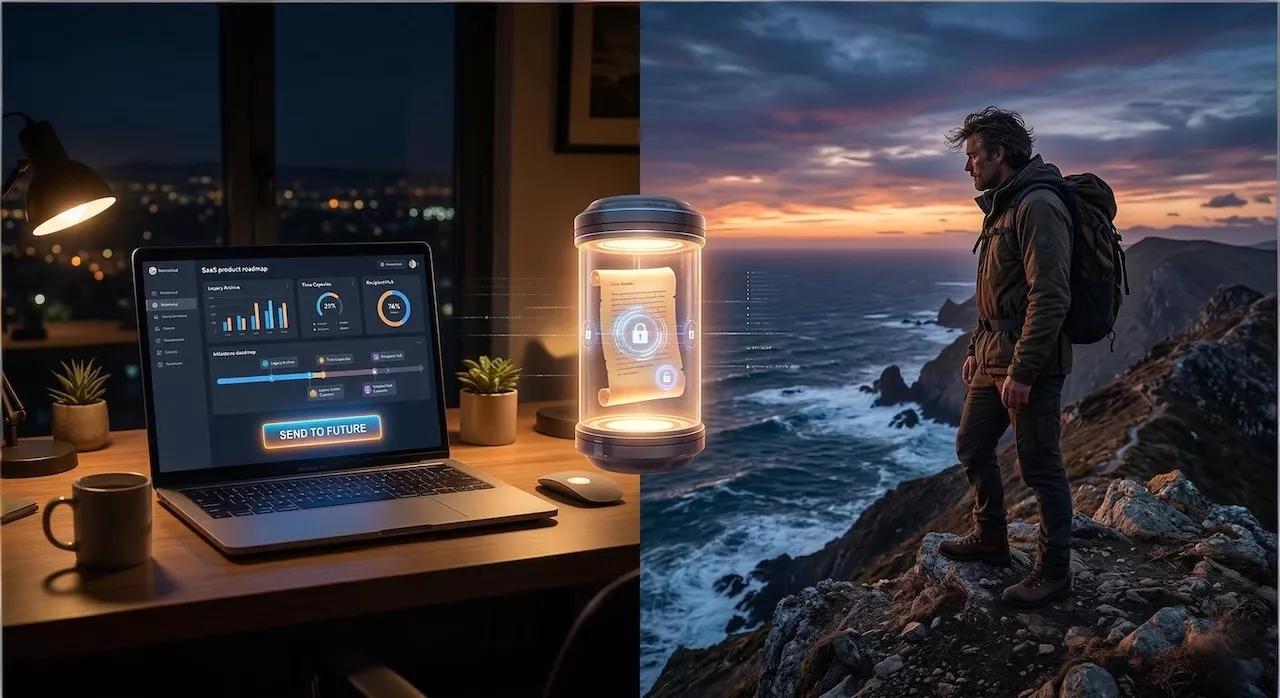
Why I Built EterMail: A Time Capsule for the People I Love Most
I’m a Product Manager who spends all week optimizing for the "immediate now." But getting lost off the grid on a mountain ridge made me realize I had zero infrastructure for the "forever." Here’s why I stopped worrying about conversion rates for a moment and built EterMail—a secure, tamper-proof digital time capsule for the people I love most.
The Light You Leave On: Finding Milestones in the Quiet Work of Letting Go
Why the truest love milestone isn't the relationship you release—it's noticing which daily habits became haunting, and finding courage to turn off the light.
The Quiet Harvest: Why Your Wearable's Data Bargain Costs More Than Your Privacy
Your wearable promises health insights, but sells a permanent map of your body. Discover what your doctor actually needs—and what you're really giving away.