There is a specific afternoon that arrives without warning. You are cleaning out your phone, perhaps because storage is full, perhaps because you have finally run out of excuses to avoid the task. You scroll to the saved messages. Their name appears, still assigned the ringtone you chose together in some parking lot years ago. You press play. The voice fills your kitchen, impossibly close, saying something ordinary—I'm at the store, do we need milk?—and you realize, with a physical sensation like falling through a floor, that this is the last time you will let yourself hear it. You delete the file. The silence that follows is not empty. It is the sound of a milestone being crossed.
The Weight of Acoustic Evidence
We have always been a species that mistrusts our own memories. Before smartphones, we pressed faded photographs to our chests, replayed stories until they became incantations, kept ticket stubs and dried flowers in shoeboxes whose locations we could map in the dark. Now we carry the voices of the dead and the departed in our pockets, accessible at 3 AM with a few taps, and we tell ourselves this is preservation. We tell ourselves we are honoring them. But there is a quieter truth we rarely examine: we are also afraid that without the recording, we will forget the exact frequency of their tenderness, and that forgetting will mean the love was never truly there.
The voice memo from the grocery store. The drunken confession left at 2 AM. The message they sent from the airport, breathless, promising to call when they landed. These files become exhibits in a private museum, proof of a civilization that once existed between two people. We curate them with the anxiety of archivists, terrified that a single deletion will collapse the entire structure of what we meant to each other.
The Ringtone That Now Belongs to Strangers
You assigned them something specific, didn't you? Not the default chime that announces the world at large, but a song that meant something, or a melody that made you smile in anticipation before you even saw their name. Now that sound arrives from pharmacy counters, from conference rooms, from the phone of someone on the bus who will never know why you flinched. The body remembers before the mind catches up. Your nervous system has been trained to associate that frequency with a particular chemical cascade: dopamine, oxytocin, the specific relief of being chosen by someone you chose in return.
This is the acoustic archaeology of love's residue—not the grand monuments, but the fragments that surface in ordinary moments. The catchphrase you catch yourself using, their syntax suddenly emerging from your own mouth like a ventriloquism you never consented to. You say it, and for a half-second, you are wearing them. Then you hear yourself, and the costume fits wrong, and you understand that you are not channeling them but rebuilding them from scraps, a collage that approximates but never quite resurrects.
The Grocery Store Voice Memo You Cannot Archive
There is a particular cruelty to the mundane recordings. The dramatic declarations—I love you, I'm sorry, please don't go—we expect to wound us. We brace for them. But the voice memo from the grocery store, the one where they are debating between two brands of pasta sauce, where you can hear the cart wheels squeaking and someone paging the manager in the background—this is the one that dismantles you. Because it contains the texture of a life being lived alongside yours, the ambient noise of a future you were both building without knowing you were building it.
You cannot archive this properly. You cannot file it under "Grief" or "Love" or "Evidence." It exists in a category for which we have no name, and so it stays on your phone, neither played nor deleted, a digital Schrödinger's cat that keeps both possibilities alive: the them that existed, and the you that existed with them.
The Milestone Nobody Prepares You For
We have rituals for the beginnings of love. The first date, the first kiss, the first time you leave a toothbrush at their apartment. We have rituals for the endings: the returned boxes, the changed locks, the blocked numbers, the friends who arrive with wine and no questions. But we have no language for the middle distance, the long aftermath where the love has ended but the evidence persists, where you are neither fully attached nor fully free. The afternoon you listen to the voicemail for the last time is a milestone without a card, a graduation no one celebrates.
It requires a specific courage, one we do not adequately honor. The courage to trust that the tone of devotion can live inside you without needing the technology to prove it ever sounded like that. The courage to believe that your memory, fallible and human and prone to revision, is still a sufficient vessel. The courage to let the voice become memory, and the memory become something quieter than proof—something closer to integration, to the understanding that you were loved, and that this fact does not require a file size to remain real.
Digital Amber and the Illusion of Permanence
We are told that digital preservation is eternal, but this is a lie we have agreed to tell ourselves. Files corrupt. Platforms disappear. The cloud is someone else's computer, and someone else's business model, and someone else's decision about what deserves to survive. More importantly, the preservation of the voice is not the preservation of the relationship. The MP3 contains the sound waves but not the context: the way they looked at you when they said it, the temperature of the room, the specific hunger you had for each other that made ordinary words feel like communion.
We preserve these fragments in digital amber, and we mistake the amber for the life. The mosquito suspended in resin is not the forest. The recording of the voice is not the conversation. The milestone we are actually reaching for is not technological permanence but emotional completion: the moment when we can carry the essence without needing the artifact, when we trust ourselves to be the living archive.
Speaking Their Catchphrase and Hearing the Costume
It happens in the shower, or while driving, or in the half-waking moment before coffee. Their phrase emerges from your mouth, perfectly replicated, and you freeze. For a moment you are uncertain: are you honoring them, or performing them? Are you keeping them alive, or keeping yourself trapped in a role that no longer fits? The catchphrase sounds like costume in your own mouth because you are no longer the person who existed in the conversation where that language was native. You have become someone else, someone who learned their syntax but never fully inhabited it, someone who is now, finally, building a vocabulary of their own.
This is not betrayal. This is the slow, unglamorous work of becoming the person who leaves the voicemail—the one who does not need to press play, who does not call the number just to hear the recording, who has forgotten the exact cadence of how their name was said and has found that forgetting is not erasure but evolution.
The Courage to Let the Voice Become Memory
What if the truest milestone is not the love we preserve but the love we release? Not the digital amber but the internal architecture we build from what we have learned? The deleted voicemail does not delete the relationship. It relocates it. It moves the evidence from external storage to the body, to the nervous system, to the way you now say I love you with more precision because you once heard it said poorly. The voice becomes memory, and the memory becomes practice, and the practice becomes the person you are now: someone who was loved, who loved, who learned the frequency of devotion and can now generate it themselves.
There is a future afternoon waiting for you. You will be cleaning out your phone, or you will not be cleaning it out at all—you will simply realize, with the soft surprise of a habit broken without announcement, that you have not played the message in months, that you no longer remember where you filed it, that the ringtone has been changed or the number has been reassigned or the platform itself has become obsolete. You will understand that you have crossed the milestone without marking it, and the crossing itself will be the proof that you were ready to cross.

The Technology of Trusting Yourself
I spend a lot of nights alone with screens. Not the romantic kind of solitude—just me, some LLM running in a terminal, and the faint hum of a server rack somewhere in Virginia, mapping out architectures until 2 or 3 AM. That kind of digital isolation teaches you something about voices across time. You start to understand that the most important conversations are the ones where someone is no longer there to respond, where you're essentially talking into a void and hoping the future has ears.
The need to preserve, to send forward, to trust that what matters will survive the erosion of time and memory—this is ancient. The methods are new. I built EterMail because I kept losing things. Not to hardware failure, but to the softer corruption of my own avoidance: the draft I never sent, the letter I wrote at 3 AM and deleted by dawn, the voice memo I meant to save but couldn't bear to hear again. The best way to fight forgetting isn't taking another screenshot; it's setting an alarm for the future. By using EterMail to set a delivery date 5 years from now, you completely free yourself from the anxiety of the present. You write the letter while the feeling is raw, schedule it for the Tuesday you know you'll need it, and let the system carry what you cannot yet carry yourself.
A platform that lets you write to your future self, to your future children, to the anniversaries and graduations and quiet Tuesdays you cannot yet imagine, is not replacing the voicemail. It is offering a different kind of preservation: intentional rather than accidental, composed rather than overheard, a letter written in full knowledge of the distance it must cross rather than a fragment snatched from the ordinary noise of a life still being lived.
The courage to delete the voicemail is the same courage that allows you to write the letter you will not open for ten years. Both require trust in the future self. Both require the belief that you will still be there, still capable of feeling, still able to recognize the tone of devotion even when the original voice has been returned to silence. The milestone is not the preservation. The milestone is the becoming.
<
The Sound of a Milestone Being Crossed
The silence after deletion is not empty. It is the sound of a door closing that you once believed needed to stay open. It is the sound of your own voice, finally, filling the space where another's used to be. It is the sound of trust—not in technology, not in permanence, but in the strange, resilient, continuously revising animal of your own memory, your own capacity to love and to lose and to continue, changed but unbroken, into the rooms you have not yet entered.
You will carry the tone of devotion. You will generate it yourself. You will become, at last, the person who leaves the voicemail, and the person who does not need to save it, because you have learned, finally, that the love was never in the recording. It was in the listening. It was in the being there. It was in the ordinary afternoon, the grocery store, the question about milk, the answer you gave without knowing it would one day be the last ordinary conversation you would ever have.
The voice becomes memory. The memory becomes you. And you, memory and all, become the person who walks forward, into the silence that is not empty, into the future that does not need proof, into the love that persists not because it was preserved but because it was real, and because you were there, and because you remain, still capable of being changed by what you have lost, still willing to be changed again by what you have not yet found.
What is EterMail?
EterMail is a revolutionary time capsule service that allows you to send messages, photos, and videos to the future (up to 30 years). Seal your memories and thoughts today, and they'll be delivered when the time is right.
Time Capsule
Send messages up to 30 years in the future
Rich Media
Text, photos, and videos supported
Secure & Private
Your memories are safely encrypted
EterMail Team
We're the team behind EterMail, dedicated to helping you preserve and share timeless messages with your loved ones. Our mission is to make it easy to express your love, share your wisdom, and create lasting connections that transcend time.
Frequently Asked Questions about Love & Milestones
How do you know when you're ready to delete a loved one's voicemail?
Why do mundane voice memos hurt more than dramatic declarations?
Is forgetting the exact sound of someone's voice a betrayal of their memory?
Related Articles
Why I Built EterMail: A Time Capsule for the People I Love Most
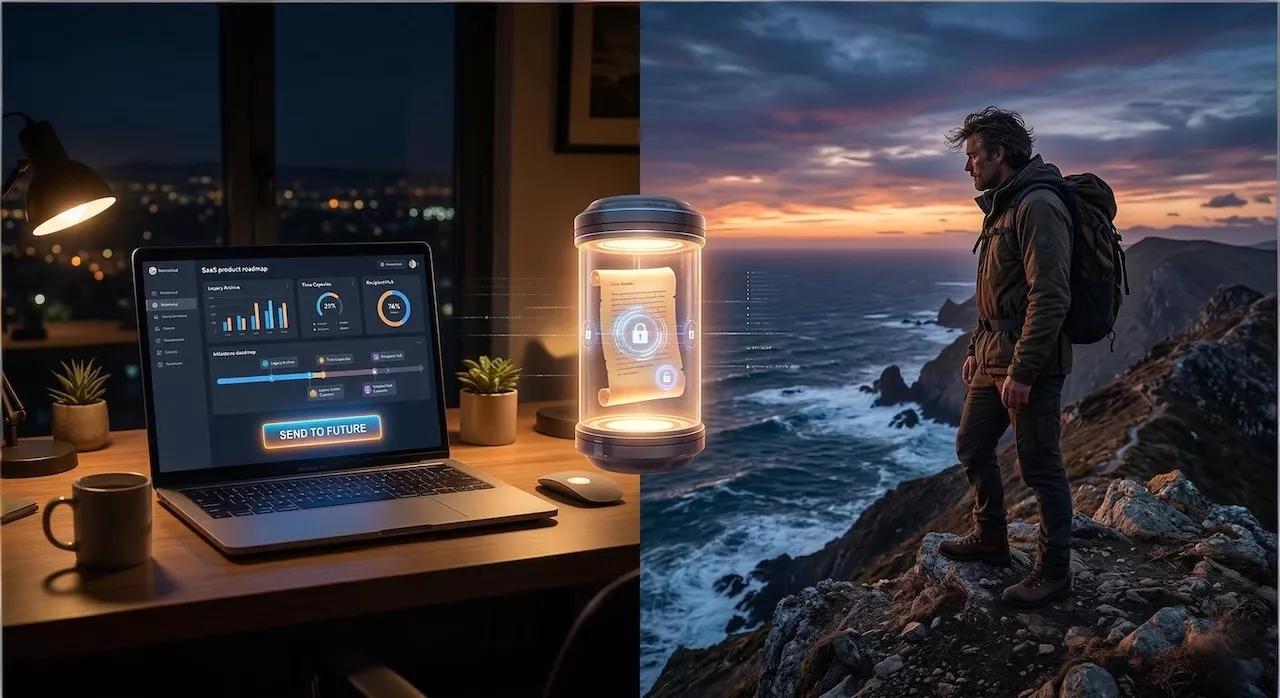
I’m a Product Manager who spends all week optimizing for the "immediate now." But getting lost off the grid on a mountain ridge made me realize I had zero infrastructure for the "forever." Here’s why I stopped worrying about conversion rates for a moment and built EterMail—a secure, tamper-proof digital time capsule for the people I love most.
The Cartography of Inherited Scent: How We Become Perfumers of Love for Our Children, and What We Lose in the Translation
We curate our very chemistry for our children—until they outgrow the fragrance of our love. What remains when they no longer recognize us as home?

The Last Unrecorded Window: When Your Eyes Become Someone Else's Surveillance Feed
Your eyes are the last unrecorded vantage point of your life. What happens when face recognition turns your gaze into harvestable data?