
There is a photograph from our second anniversary that no one took. The reservation was for eight o'clock at the place where we'd had our first date, the one with the amber lighting and the wine list we couldn't afford then and still pretended we could now. Instead, I spent that evening in a hospital waiting room, eating peanut butter crackers from a vending machine, watching the fluorescent lights buzz above a woman who was crying into her phone in a language I didn't speak. His appendix had ruptured sometime between the appetizer neither of us would eat and the moment he went gray and said, very calmly, that something was wrong.
I remember the crackers more than I remember the surgery. The particular way they stuck to the roof of my mouth. The way I counted ceiling tiles to keep from imagining what was happening three floors above me. The way I realized, with a clarity that felt almost violent, that I had already decided to stay before I consciously chose to. The reservation didn't matter. Nothing mattered except the fact of my presence, my stubborn, unglamorous, elected presence in that room.
The Milestones No One Frames
We are taught to recognize love in its heights. The proposal, the wedding, the anniversary dinners, the vacations where everyone looks happy in the photographs. But love's most profound evolution happens in the valleys it never occurs to us to document. The true milestones are invisible by design. They resist Instagram because they involve ugliness we have been conditioned to hide—vulnerability that looks like weakness, devotion that resembles damage, intimacy that smells like vomit and hospital antiseptic.
The night you sit on the bathroom floor while they purge tequila and self-loathing into the toilet, holding back their hair not because it's romantic but because someone has to be the witness. The morning after the fight where they said something unforgivable, and you absorbed it, and you chose to understand that cruelty as symptom rather than essence, saying "I'm still here" instead of "how dare you" because you've learned to distinguish the person from the pain that speaks through them.

These are not the stories we tell at dinner parties. They lack the narrative satisfaction of transformation, the clean arc of conflict and resolution. They are static, repetitive, stubbornly ongoing. The milestone is not the overcoming but the endurance itself. The thousandth time you choose the relationship over the exit, not because you're trapped, but because you've built something that can only exist through maintenance, through the daily, uncelebrated labor of remaining visible when visibility costs something.
The Architecture of Elected Suffering
There is a dangerous honesty in admitting that love involves suffering we choose. Not the suffering of abuse or erasure—those are not elections but imprisonments—but the suffering of witnessing someone you love at their most unlovable and refusing to look away. The drunk before they recognize they're drunk. The depression that makes them cruel, the anxiety that makes them small, the grief that hollows them out until you can see through them to the wall behind.
You learn their patterns before they do. The particular cadence of their voice when they're about to spiral. The websites they visit when they feel worthless. The passwords you keep for the accounts they might sabotage in a dark hour, not because you don't trust them, but because you've accepted that love sometimes means holding what they cannot hold for themselves, becoming the baseline they return to rather than the high they seek.
This is not martyrdom. It is, strangely, a kind of practical mysticism—the belief that the person beneath the episode is real, is continuous, is worth more than the accumulated weight of their worst moments. You are not saving them. You are simply refusing to participate in their abandonment, even when they are trying to abandon themselves.

Becoming the Baseline
There comes a moment you cannot prepare for, the moment you realize you have become the baseline. Not the excitement. Not the fantasy. The baseline. The person they return to when the party ends, when the manic phase crashes, when the promotion doesn't come through, when the diagnosis arrives. The one who is still there when the performance of living becomes too exhausting to maintain.
This is not the role we are taught to want. We are raised on stories of being chosen, of being special, of being the exception that proves someone's rule. The baseline is the opposite of exceptional. It is dependable, predictable, unremarkable. It is the person who knows how you take your coffee, who has seen you cry until your face swells, who has memorized the particular sound of your breathing when you're finally, actually asleep.
But there is a secret power in baseline-hood. You become the proof that they exist when they cannot prove it themselves. The memory they can borrow when their own becomes unreliable. The continuity that outlasts their discontinuity. This is not romantic in any conventional sense. It is better than romantic. It is structural. It is the foundation without which no romance could survive its own weight.
The Visibility of Remaining
Perhaps the most radical act in love is remaining visible when the person you love is determined to make themselves unlovable. When they deploy their full arsenal of pushing-away—cruelty, silence, chaos, disappearance—and you refuse to be pushed. Not because you're stubborn or codependent, but because you've learned to read these gestures as communication rather than conclusion. The message beneath the message: I am unlovable right now, and I need to know if you will believe otherwise on my behalf.
This is the trust they cannot articulate. The test they don't consciously design. The night they scream that you should leave, and you don't, not because you're trapped, but because you've developed the discernment to hear the fear beneath the fury. Your visibility becomes their anchor to a self they cannot currently access. You are holding the space they will eventually return to, keeping it warm, keeping it lit, refusing to let it be claimed by their temporary darkness.

What We Owe the Future Versions of This Love
I think sometimes about the letters I might write to the person I was in that hospital waiting room, or to the person I will be when the next unglamorous milestone arrives. The future self who will need to remember that she chose this, that it was not obligation but election, that the crackers and the fluorescent lights and the fear were part of the texture of a love she was building without knowing its final shape.
There is a practice in this—the act of documenting love not at its celebrations but at its crucibles. Writing to the future to say: this is who we were when it was hard. This is who we became by staying. This is the evidence that our love was not merely the product of good times and compatible aesthetics, but of something we forged in the moments when forging was the only alternative to dissolving.
The letters we send forward become witnesses. They outlast our own unreliable memories, our tendency to rewrite the past in light of its ending. They say: we were here, we stayed, we became something we could not have planned. And in sending them, we create a kind of time capsule—not of objects, but of choices. The accumulated weight of all the nights we didn't leave, all the mornings we started over, all the invisible milestones that no one photographed but that made us, finally and irrevocably, us.
I built EterMail because I know what it means to need proof that someone stayed. I spend my nights coding, sometimes until 2 or 3 AM, "pair programming" with LLMs, mapping architectures for a platform that will outlast my own memory. The irony isn't lost on me: I'm a Silicon Valley builder who's spent years in e-commerce, games, now SaaS—hand-to-hand combat with cold servers and complex APIs—yet what I'm actually building is a bridge between the physical and digital worlds, a way to preserve the softest parts of being human. I have this wild fantasy, something straight out of The Matrix, of uploading consciousness into the digital realm. EterMail is my first spaceship for that journey—not for escaping death, but for defying forgetting. The best way to fight the erosion of memory isn't taking another screenshot that gets buried in a camera roll; it's setting an alarm for the future. By using EterMail to schedule a letter five years from now, you free yourself from the anxiety of the present. You let your future self receive exactly what she needs to remember: that you chose this, that you stayed, that the unglamorous moments were the real architecture of your love.
The Courage of Continuation
We misunderstand courage. We imagine it as dramatic, as the grand gesture, the leap, the fight. But the courage love most often requires is the courage of continuation. The decision, made daily and without fanfare, to keep showing up in the same room as another person's complexity. To sit with the discomfort of not being able to fix them. To absorb the impact of their worst without making it about your injury. To believe, without evidence, that the current darkness is not the final word.
This is the milestone that matters most, though it will never appear in a scrapbook. The night you became the person who stays. The morning you chose understanding over retaliation. The anniversary that happened in a hospital instead of a restaurant, that taught you something about love that no celebration could have conveyed.
The truest version of us is not the one we present in light. It is the one we discover in darkness, the one we build through repetition and refusal, the one that emerges only when love has stopped being easy and started being work—meaningful, transformative, life-altering work. The work of remaining visible. The work of being the baseline. The work of saying, when everything in you wants to leave or fight or disappear into your own pain: I'm still here. I'm still here. I'm still here.
What is EterMail?
EterMail is a revolutionary time capsule service that allows you to send messages, photos, and videos to the future (up to 30 years). Seal your memories and thoughts today, and they'll be delivered when the time is right.
Time Capsule
Send messages up to 30 years in the future
Rich Media
Text, photos, and videos supported
Secure & Private
Your memories are safely encrypted
EterMail Team
We're the team behind EterMail, dedicated to helping you preserve and share timeless messages with your loved ones. Our mission is to make it easy to express your love, share your wisdom, and create lasting connections that transcend time.
Frequently Asked Questions about Love & Milestones
How do you write a letter to your future spouse about the hard times you've survived together?
What should I include in a time capsule about my marriage for my future children?
How do couples process trauma together without damaging the relationship?
Related Articles

The Architecture of Coupled Privacy: Why the Deepest Love Lives in the Vault
What if the truest milestone is not the love we display, but the courage to carry what we know alone? Explore the vault of coupled privacy.

The Unconscious Milestone: Learning to Sleep Beside Someone Again
The truest intimacy isn't declared in daylight—it's the courage to be unconscious together. Discover why sleeping beside someone is love's quietest milestone.
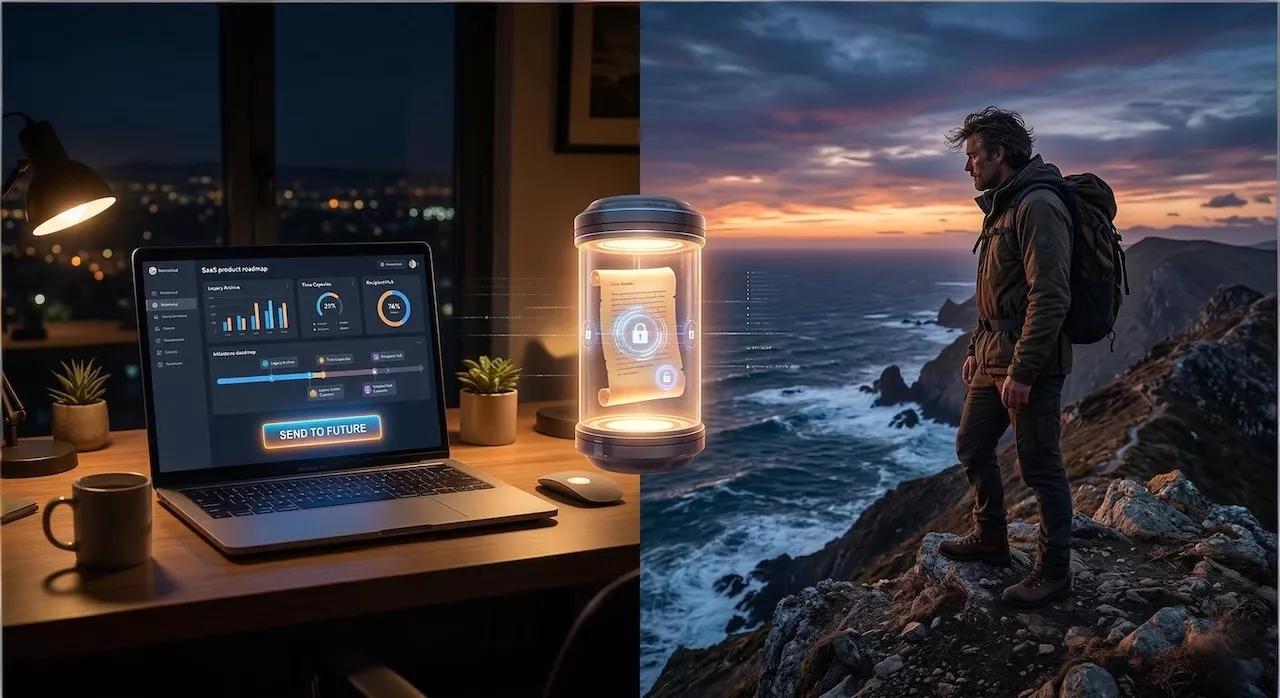
Why I Built EterMail: A Time Capsule for the People I Love Most
I’m a Product Manager who spends all week optimizing for the "immediate now." But getting lost off the grid on a mountain ridge made me realize I had zero infrastructure for the "forever." Here’s why I stopped worrying about conversion rates for a moment and built EterMail—a secure, tamper-proof digital time capsule for the people I love most.