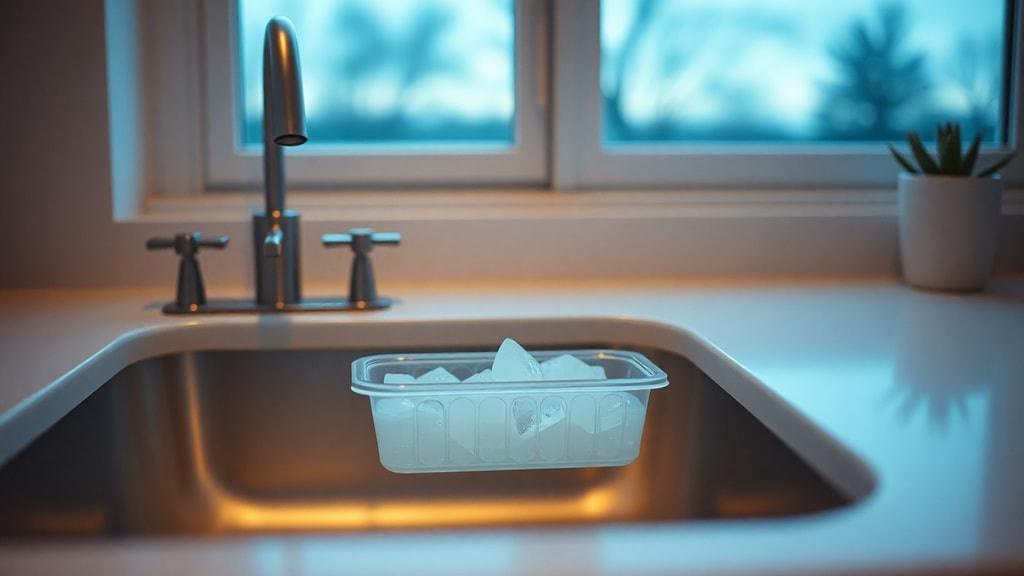
The evening you finally refill the ice tray the way you like it—full cubes, not the half-moon shapes they insisted prevented spillage—and you don't hear their voice correcting you, don't feel the phantom weight of their preference leaning over your shoulder, is an evening you probably won't notice at first.
You will simply fill the tray. Place it back in the freezer. Close the door with a soft thud. Then, hours later, standing in the dark kitchen with a glass of water, you will realize: you did not perform rebellion. You did not perform grief. You did not perform them at all. You just chose something, small and unremarkable, for yourself.
That is the strange geography of healing. It does not always arrive in sweeping revelations or anniversary breakdowns or the first holiday survived. Sometimes it arrives in the shape of an ice cube.
The Domestic Afterlife of Love
We do not talk enough about how much of intimacy is administrative. Love, in its daily form, is a thousand tiny negotiations: how the towels are folded, which side of the bed is yours, whether the thermostat lives at 68 or 71, whether dishes left overnight are an act of war or simply a Tuesday. These are not trivialities. They are the architecture of cohabitation. They are how two people learn to occupy space without constantly bumping into each other.
When someone leaves—through death, divorce, distance, or the slow erosion of whatever held you together—their preferences do not leave with them. Not immediately. They linger in the hardware store choices, the grocery list habits, the muscle memory of reaching for the mug they always used. For a while, you keep the house the way they liked it because grief has a way of turning memory into maintenance.
You hang the toilet paper the way they preferred. You set the thermostat to their temperature. You buy the half-moon ice trays because anything else feels like betrayal, or erasure, or admission that the world has already moved on without them.
Rebellion as a Stage of Grief
There is a period, sometimes brief and sometimes stubborn, where every domestic choice becomes a referendum on the loss. You leave dishes in the sink overnight not because you are tired, but because you can. You crank the thermostat three degrees warmer not because you are cold, but because their comfort no longer governs the room. You buy the wrong ice trays on purpose.
This is not pettiness. It is grief trying to find a body. When the person is gone, their absence is everywhere and nowhere. It has no edges. So you give it edges. You turn the smallest rituals into battlegrounds because battlegrounds, at least, have clear sides. You are here. They are there. You are warm. They are gone.
The problem is that rebellion requires an opponent. And the dead, the departed, the no-longer-here do not argue back. They do not feel the sting of your defiance. Only you do. Only you are left standing in a too-warm kitchen at midnight, proving a point to no one, wondering why the victory tastes like ash.
The Quiet Territory of Your Own Preferences
Healing, when it finally comes, does not feel like winning. It feels like forgetting to fight.
One day you set the thermostat to 71 not because they hated it, but because you are cold. One day you leave a dish in the sink because you are genuinely too tired to deal with it, and there is no one to perform resentment for. One day you buy the ice trays you actually like, and the choice is so ordinary it does not even register as symbolic.
This is the ungoverned territory the prompt asks about: the small, unshared victories of a life rebuilt for one. It is not that you have stopped loving them. It is that you have stopped organizing your love around opposition. You have stopped needing their absence to explain your choices.
There is something quietly radical about this. We are taught that love is fusion, that partnership means compromise so thorough it blurs the borders of self. And then, when the partnership ends, we are left with a map drawn by two people and only one person to read it. The work of healing is not just mourning what was. It is relearning what you wanted before you learned to want things together.
The Letters We Do Not Send
Here is where the human problem meets the possibility of preservation. We often think of legacy as the big things: the eulogy, the will, the stories told at funerals. But most of what we lose is smaller. The way they said your name when you were being ridiculous. The note they left on the bathroom mirror. The argument about ice trays that somehow became a language of love.
These are the memories that slip through the cracks of official grief. They do not fit neatly into photo albums. They are too ordinary for obituaries. And yet they are the texture of a shared life.
I know this because I've spent too many nights alone at 2 AM, "pair programming" with a glowing screen, building things that outlast conversations. There's a particular loneliness to those hours—me talking to an LLM, mapping architectures, the only voice in the room synthetic and patient. It taught me something about dialogues across time, about wanting to leave a mark that persists when the present moment dissolves. The cyber-romantic in me has always wanted to build bridges between what we feel now and what we might need to remember later.
This is why the act of recording them matters—not to hold on forever, but to honor what actually happened. A letter to your future self, written in the thick of loss, can become a map back to your own evolution. A message scheduled to arrive years from now can remind you that the ice tray mattered. That the thermostat mattered. That the small, stubborn preferences you are reclaiming were always part of the person you were becoming.
The best way to fight forgetting isn't taking another screenshot; it's setting an alarm for the future. By using EterMail to set a delivery date 5 years from now, you completely free yourself from the anxiety of the present. You write the letter while the memory is still warm, while the grief still has texture, and you trust that your future self—the one who fills the ice tray without thinking—will need that witness. Will need to remember that this ordinary Tuesday was once extraordinary, and that you survived it.
What It Means to Heal in Private
There is no ceremony for the night you refill the ice tray correctly. No one will send flowers. No one will ask, six months later, how you are holding up, and you will not think to mention it because it does not sound like grief and it does not sound like healing. It sounds like nothing.
But that nothing is the whole point.
Healing is not a performance. It is not even, most of the time, a feeling. It is a series of small surrenders: the moment you stop checking their side of the bed, the moment their mug moves from shrine to cupboard, the moment you realize the house is no longer a museum of what you had but a place where you are, slowly, living again.
This does not mean the love was small. It means the love was real enough to leave residue. And real enough that you do not have to keep polishing it every day to prove it existed.

The Permission to Be Ordinary Again
If you are in the middle of this—if every drawer you open contains a ghost, if the grocery store feels like a minefield of their favorite brands, if you are still buying the wrong ice trays on purpose—know that the rebellion has its place. It is a kind of love, inverted. It is how some of us learn, slowly, that we are still here.
But also know that the better day is not the day you win the argument with their memory. It is the day you stop needing the argument at all. The day you fill the ice tray the way you like it, set the thermostat to your own comfort, leave a dish in the sink without ceremony, and feel—not relief, not triumph, but the quiet, ungoverned ordinariness of being yourself.
That is the life built for two that still contains you. That is the healing no one warns you about because it does not look like healing. It looks like a Tuesday. It looks like a kitchen at midnight. It looks like ice cubes, full and square, clicking into a glass of water you poured for no one but yourself.
And maybe, if you are ready, it looks like writing it down. Not for them. For the person you are still becoming.
What is EterMail?
EterMail is a revolutionary time capsule service that allows you to send messages, photos, and videos to the future (up to 30 years). Seal your memories and thoughts today, and they'll be delivered when the time is right.
Time Capsule
Send messages up to 30 years in the future
Rich Media
Text, photos, and videos supported
Secure & Private
Your memories are safely encrypted
EterMail Team
We're the team behind EterMail, dedicated to helping you preserve and share timeless messages with your loved ones. Our mission is to make it easy to express your love, share your wisdom, and create lasting connections that transcend time.
Frequently Asked Questions about Healing & Remembrance
Why do small household habits trigger grief after someone dies?
How do you know you are healing from grief rather than just moving on?
What should I write in a letter to my future self after losing someone?
Related Articles

The Morning You Stop Checking the Obituaries: On the Quiet Geography of Outliving Your Grief
What happens when you finally stop searching for proof they're gone? A meditation on the strange, ordinary moment grief loosens its grip without asking permission.

Writing to the Self Who Will Mourn: The Strange Tenderness of Letters to Future Grief
Why we write letters to our future grieving selves—attempting to preserve the exact sound of a father's laugh before we ever need to miss it.

Why I Built EterMail: A Time Capsule for the People I Love Most
I’m a Product Manager who spends all week optimizing for the "immediate now." But getting lost off the grid on a mountain ridge made me realize I had zero infrastructure for the "forever." Here’s why I stopped worrying about conversion rates for a moment and built EterMail—a secure, tamper-proof digital time capsule for the people I love most.