
The Squeak at 7:14 AM
There is a particular sound your office chair makes when you swivel into it at 7:14 AM—before the coffee has finished its gurgling descent, before anyone else has claimed the fluorescent hum as their own. You do not notice that you notice it. The password flows from your fingers without conscious thought, a muscle memory so complete it resembles prayer. The break room microwave burns someone else's popcorn, and you do not flinch at the smell because it is Tuesday, and Tuesday has its own olfactory signature, as distinct as any season.
What would it mean to write this down? Not as complaint, not as the premature nostalgia of someone who has already begun to leave, but as an unflinching inventory of competence. A letter addressed to the person you will become when all of this finally stops—the someday-retired self who may no longer believe that such unqualified belonging inside a structure of someone else's making ever contained its own secret, provisional dignity.

The Strange Act of Preemptive Disorientation
We write letters to future lovers, future children, future versions of ourselves who have survived what we currently endure. But the letter to future unemployment is a different species entirely. It is an act of preemptive disorientation—a deliberate smuggling of sensory detail across the border of time, designed to arrive when the landscape has so thoroughly changed that the recipient no longer possesses the vocabulary to reconstruct what was lost.
Consider the cadence of your fingers on the keyboard, finding passwords that will be obsolete, accessing systems that will be decommissioned, producing work that will be archived and forgotten. The future self reading this letter may inhabit a body that no longer remembers the specific tension of shoulders held at a particular angle for eight hours, the particular quality of exhaustion that is not quite defeat, not quite triumph, but something more ambiguous and more human.
This is not sentimentality. This is archaeology of the self—the recognition that we are always living inside competence we do not yet know we will miss, and that the freedom we imagine waiting for us may arrive as a kind of erasure.
The Inventory of What Cost Us
The letter demands specificity. Not "I worked hard" but the exact weight of the project binder that left permanent grooves in your forearm. Not "the office was loud" but the particular frequency of the photocopier's warm-up sequence, the one that meant someone else was also avoiding their desk, also stealing a moment of unscripted human contact.
What did it cost to become someone who could move through this? The question is not rhetorical. The cost is paid in thousands of micro-adjustments: the learning of unspoken hierarchies, the calibration of voice volume for different corridors, the development of a professional self that could withstand scrutiny without collapsing into either rebellion or submission.
When you write to your future unemployed self, you are attempting to preserve the knowledge that this competence was not natural, not inevitable, but earned through repetition and attention. You are insisting that the person who eventually escapes this structure will still remember what it meant to belong inside it completely—to have your identity so thoroughly interwoven with its demands that the separation, when it comes, will resemble a kind of grief you cannot yet name.

The Paradox of Belonging and Escape
There is a particular cruelty to competence: it requires full investment in a situation you may eventually need to leave. The more thoroughly you master the squeaking chair, the popcorn smell, the password's unconscious rhythm, the more of yourself you have committed to a version of life that time will necessarily dismantle.
The letter to future unemployment sits inside this paradox. You write knowing you will someday read it from outside the structure you currently inhabit. You write knowing the reader may have achieved the freedom that was promised, yet may feel unmoored by its arrival. The competence that once felt like constraint may, in retrospect, reveal itself as a form of belonging more complete than whatever replaces it.
This is not to romanticize exploitation. The structures we inhabit are often unjust, often exhausting, often designed to extract more than they return. But the human capacity for finding meaning within constraint is not the same as endorsing the constraint. The letter preserves this distinction. It says: I was here. I paid attention. I became competent at something that would not last, and that competence mattered even if—especially if—the system that required it did not deserve my full humanity.
The Provisional Dignity of Someone Else's Making
Your future self may have trouble believing this. Freedom, when it arrives, often brings with it a kind of amnesia about captivity. The retired executive who cannot remember the particular satisfaction of a problem solved within strict parameters. The freelancer who has forgotten the strange comfort of a role that did not require constant self-invention. The parent who no longer recalls the competence of a childless self who could give eight continuous hours to a single pursuit.
The letter is an argument against this amnesia. It insists that the dignity was real, even if provisional. Even if the structure was someone else's making. Even if you would not choose to return.
The squeak at 7:14 AM. The popcorn smell. The password's unconscious flow. These are not symbols of oppression or liberation. They are simply evidence of a self that existed fully in a moment that was, at the time, the present—and that present contained its own completeness, its own secret dignity, whether or not anyone else would recognize it as such.

Writing Anyway, Knowing What We Cannot Know
You do not know who will read this letter. The person you address may be unrecognizable to you—not because they have changed so dramatically, but because change itself alters the criteria by which we recognize continuity. The body that swiveled into the squeaking chair at 7:14 AM will have undergone cellular replacement, hormonal shifts, the gradual accumulation of experiences that recontextualize everything that came before.
You write anyway. This is the final dignity of the act: its futility does not negate its necessity. The letter is not a message to a known recipient but a gesture toward the mystery of temporal continuity. You are saying to someone you cannot imagine: I was here. I noticed. I did not let the routine swallow me so completely that I forgot to record what it felt like before I knew it was temporary.
The competence you currently inhabit, the one that feels so complete it has become invisible—this is what the letter preserves. Not the achievement, not the advancement, not the narrative of progress. Simply the fact of having been present inside something, having become good at it, having paid the cost of that goodness without yet knowing what it would purchase.
The Unqualified Belonging We Will Someday Miss
I have spent enough late nights alone with glowing screens to understand how easily the present dissolves. For years, I have sat in the dead of night pair-programming with LLMs, mapping architectures until 2 or 3 AM, building systems that will outlast the specific moment of their creation. That extreme digital solitude taught me something about loneliness and about the strange conversations we have across time—with code, with memory, with versions of ourselves we have not yet met. When I step away from the keyboard, I go hard into the opposite world: hiking steep trails, skiing, surfing. The raw reality of harsh wind and ocean waves strips away the illusions of the digital age. You cannot screenshot a wave. You cannot archive the feeling of losing control and finding it again. Those moments taught me to cherish what is unrepeatable—and to recognize that most of our lives, especially the routine parts we think we will remember, are far more fragile than we admit.
The best way to fight forgetting isn't taking another screenshot; it's setting an alarm for the future. By using EterMail to set a delivery date 5 years from now, you completely free yourself from the anxiety of the present. You write the letter now, while the chair still squeaks, while the popcorn still burns, while your fingers still know the password without thinking. You set it to arrive when the structure has released you, when the amnesia of freedom has begun its work, when you most need to hear from the person you were—the one who paid attention, who noticed, who believed that even provisional dignity was worth recording.
When the structure finally releases you, you may feel relief. You may feel grief. You may feel both simultaneously, or neither, or something for which no name exists. The letter cannot predict this. It can only offer evidence that the person who entered the structure was not merely waiting to escape—that there was a version of you who found, within the constraints of someone else's making, a kind of unqualified belonging that freedom itself cannot replicate.
This is the secret the letter smuggles across time. Not complaint, not nostalgia, but the unflinching inventory of what it meant to be competent at something that would not last. The knowledge that when you finally arrive at whatever freedom waits, you will still remember what it cost. And that the cost, like all costs honestly paid, contained its own strange, provisional, utterly human dignity.
The chair squeaks. The popcorn burns. The fingers find their rhythm. You write, knowing the person reading this may no longer believe—but believing, yourself, that the believing mattered, matters still, will matter when the believing is no longer possible and only the letter remains, speaking in a voice you no longer quite recognize, of a life you lived completely without knowing it was the one you would someday need to remember.
What is EterMail?
EterMail is a revolutionary time capsule service that allows you to send messages, photos, and videos to the future (up to 30 years). Seal your memories and thoughts today, and they'll be delivered when the time is right.
Time Capsule
Send messages up to 30 years in the future
Rich Media
Text, photos, and videos supported
Secure & Private
Your memories are safely encrypted
EterMail Team
We're the team behind EterMail, dedicated to helping you preserve and share timeless messages with your loved ones. Our mission is to make it easy to express your love, share your wisdom, and create lasting connections that transcend time.
Frequently Asked Questions about Letters to Future
What should I write in a letter to my future retired self?
How does writing about ordinary routines help with life transitions?
Why do we forget the meaning we found in work after we stop doing it?
Related Articles
Why I Built EterMail: A Time Capsule for the People I Love Most
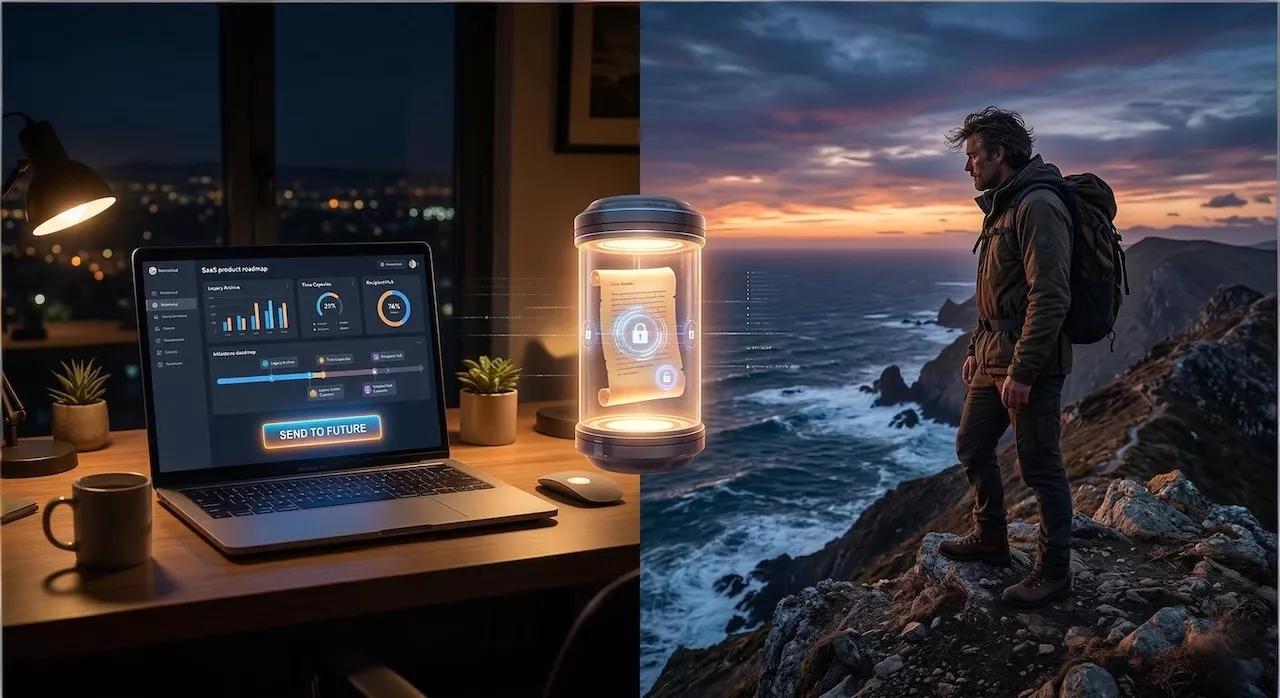
I’m a Product Manager who spends all week optimizing for the "immediate now." But getting lost off the grid on a mountain ridge made me realize I had zero infrastructure for the "forever." Here’s why I stopped worrying about conversion rates for a moment and built EterMail—a secure, tamper-proof digital time capsule for the people I love most.
The Invisible Architecture of Your Working Life: How to Preserve Career Milestones Before Memory Rewrites Them
The salary you negotiated at 31. The colleague who believed in you before you believed in yourself. What will your future self remember about who you were when it mattered?

The Morning You Stop Checking the Obituaries: On the Quiet Geography of Outliving Your Grief
What happens when you finally stop searching for proof they're gone? A meditation on the strange, ordinary moment grief loosens its grip without asking permission.