
The 3 AM Search History That Knows You Better Than Your Instagram
At 2:47 on a Thursday morning, you searched "can anxiety cause chest pain or is this actually it." You didn't post about it. You didn't story it. You closed the tab, watched a video of a golden retriever puppy falling asleep, and eventually let your phone slip onto the pillow beside you.
That search history—embarrassing, vulnerable, unheroic—contains more autobiographical truth than every carefully filtered sunset you've ever shared. And yet, when we imagine our digital legacy, we picture the highlight reel. The promotion announcements. The anniversary dinners. The vacation panoramas that required twenty minutes of patient waiting for strangers to exit the frame.
We are, all of us, curating a museum of our own lives with most of the galleries permanently closed.

The Sanitized Self: How We Became Our Own PR Departments
The shift happened gradually, then completely. We moved from blogs with raw, unspelled titles to platforms that reward polish. From LiveJournal confessions to LinkedIn accomplishments. The internet once felt like a place to discover who you were becoming. Now it functions as a permanent record of who you've decided to be.
Consider the mathematics of your digital existence. For every photo you post, there are forty-seven you deleted. For every caption you published, there are twelve drafts that felt too honest, too strange, too you. The algorithm of self-presentation demands consistency, coherence, a narrative arc that makes sense from the outside.
But the self that endures—the self your future self will recognize and need—is the one that exists in the interstitial spaces. The voice memo you recorded walking home from a job you hated, too breathless and too honest. The email draft to an ex that you never sent, each revision revealing a different stage of grief. The playlist titled "2019 don't ask" that you built during those months you still can't quite name.
These fragments lack narrative elegance. They contradict each other. They embarrass us. And precisely for these reasons, they constitute the most accurate archaeology of our becoming.
What We Lose When We Edit for Posterity
There's a peculiar violence to curation. Each deletion is a small act of self-erasure, a judgment that some version of you wasn't worth preserving. The anxious search at 2:47 AM. The forum post asking strangers whether your marriage was salvageable. The abandoned Twitter account where you tried on political opinions like ill-fitting coats.
We tell ourselves we're protecting our future selves from embarrassment. But embarrassment is simply the emotional signature of growth. The person you were at twenty-three should embarrass the person you are at forty-three. That discomfort is evidence of transformation, of consciousness expanding beyond its previous container.
More dangerously, we edit to protect others. We remove the evidence of our failures, our ugliness, our ordinary human mess, because we've internalized the idea that love requires performance. That our children, our partners, our future friends deserve a legacy of competence and serenity rather than the complicated truth of someone trying, failing, trying again.
The Paradox of the Perfect Archive
Digital preservation has created an unprecedented problem: we can save everything, so we save almost nothing worth remembering. Cloud storage expands infinitely while our tolerance for imperfection contracts to zero. We backup terabytes of data and delete the only files that mattered.
Consider what future historians—whether professional scholars or simply your own grandchildren—will actually want to understand. Not your brand partnerships. Not your aesthetic coherence. They will want to know what it felt like to be alive in this particular body, in this particular moment, with this particular set of impossible questions.
The ancient Egyptians filled tombs with objects for the afterlife: food, furniture, favorite games. They understood that the dead would want the texture of daily existence, not just the golden mask of official identity. We have inverted this wisdom. We preserve our masks with obsessive care while letting the actual substance of our lives evaporate.
The Honest Archive: Reclaiming Your Unfiltered Evidence
Building a meaningful digital legacy requires a different kind of intention—not more curation, but more courage. The courage to save what embarrasses you. The courage to document not just your conclusions but your confusions. The courage to believe that your future self, and perhaps your future loved ones, will love you more for your complexity, not less.
This doesn't mean abandoning all discernment. It means shifting your criteria. Instead of asking "Does this present me well?" ask "Does this preserve a true moment of my consciousness?" The abandoned novel outline. The angry letter you wisely never sent but whose existence proves you felt something deeply. The photo where you look tired, where the hotel room is messy, where the vacation contained struggle alongside beauty.
The most valuable inheritance you can leave is not your achievements but your process. The evidence that you were here, uncertain, wanting, alive in ways that didn't photograph well.

Time Capsules for the Unfinished Self
There's a particular loneliness to digital existence: the sense that everything we create is either permanent and public, or deleted and gone. We lack rituals for preserving the private, the provisional, the not-yet-resolved. We lack containers for the self still in formation.
I know this loneliness intimately. For years, I've spent my nights in the glow of a monitor, "pair programming" with LLMs until 2 or 3 AM, mapping architectures for products that might outlast me. That extreme digital solitude—just me, the code, and the strange half-presence of an AI—has given me a profound resonance with what it means to feel isolated while building something meant to connect. The code I write at those hours isn't polished. It's messy, exploratory, full of dead ends and sudden insights I barely understand myself. Yet those raw commits, those failed experiments, contain more of my actual thinking than any clean documentation I produce for public release.
When I finally step away from the keyboard—when I'm hiking steep trails or surfing, feeling the harsh wind strip away every digital illusion—I'm reminded that the unrepeatable moment is all we truly have. The ocean doesn't care about your personal brand. The mountain has no algorithm. What remains is the raw, unedited experience of being present, being frightened, being alive.
This is why I believe so deeply in preserving our unfiltered evidence. Not the performance, but the process. Not the announcement, but the uncertainty that preceded it.
The Permission to Be Multiple
Perhaps the deepest liberation in preserving your unedited digital legacy is the permission to contain multitudes. The you who posted earnest poetry at nineteen and cynical observations at twenty-nine and something approaching wisdom at forty-nine—these are not failures of consistency but evidence of consciousness in motion.
Social media demands we resolve into a single coherent brand. But human beings are ongoing experiments, provisional constructions, beautiful contradictions. Your digital legacy should reflect this truth, not obscure it. The playlist and the panic search. The professional achievement and the private despair. The person you were trying to become and the person you were trying to escape.
The best way to fight forgetting isn't taking another screenshot; it's setting an alarm for the future. By using EterMail to schedule a letter to yourself five years from now, you completely free yourself from the anxiety of the present. You don't need to resolve your confusion before you document it. You don't need to know how the story ends to preserve the middle. Write the messy truth, set the date, and let time do what it does—transform your raw evidence into the most precious recognition you'll ever receive.
When you finally sit down to consider what you want to preserve, what you want your future self—or your children, or your friends after you're gone—to truly know about you, start with what you've been trained to delete. The evidence of your ordinary courage. Your 3 AM uncertainties. Your unpolished, unheroic, utterly irreplaceable aliveness.
The curated self will age poorly, as all performances do. The honest self, preserved in its complexity, only accrues value. Not because it was perfect, but because it was real. Because it was yours. Because it proves, against the erasure of time, that you were here—confused, wanting, alive, and finally, finally, enough.
What would your future self recognize in the digital fragments you've preserved? And what essential evidence of your becoming have you already, perhaps too hastily, let disappear?
What is EterMail?
EterMail is a revolutionary time capsule service that allows you to send messages, photos, and videos to the future (up to 30 years). Seal your memories and thoughts today, and they'll be delivered when the time is right.
Time Capsule
Send messages up to 30 years in the future
Rich Media
Text, photos, and videos supported
Secure & Private
Your memories are safely encrypted
EterMail Team
We're the team behind EterMail, dedicated to helping you preserve and share timeless messages with your loved ones. Our mission is to make it easy to express your love, share your wisdom, and create lasting connections that transcend time.
Frequently Asked Questions about Digital Legacy
What should I include in a digital legacy beyond social media posts?
How do I overcome embarrassment about preserving my unfiltered digital history?
What happens to my digital memories if I don't make a plan for them?
Related Articles
Why I Built EterMail: A Time Capsule for the People I Love Most
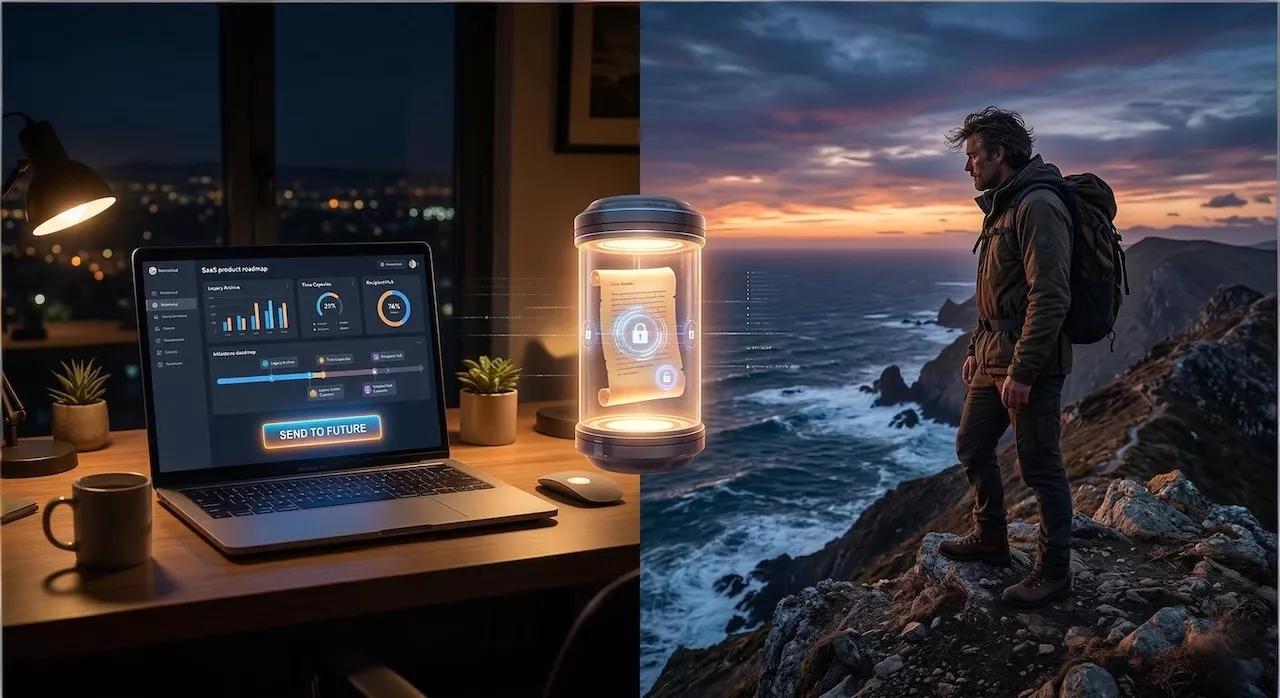
I’m a Product Manager who spends all week optimizing for the "immediate now." But getting lost off the grid on a mountain ridge made me realize I had zero infrastructure for the "forever." Here’s why I stopped worrying about conversion rates for a moment and built EterMail—a secure, tamper-proof digital time capsule for the people I love most.

The Body Remembers First: Relearning Touch When Love Has Gone Cold
How do we touch again after anger builds walls? Explore the quiet courage of physical reconciliation—and why the body heals before the heart.
When Grief Becomes Content: Who Owns Our Mourning After the Algorithm Forgets?
When grief becomes viral content, what happens to our mourning when platforms die? Explore the fragile paradox of digital legacies and how to preserve what matters.