
Oliver Sacks once wrote that life's meaning "clearly has to do with love — what and whom and how one can love." He delivered this insight not as a philosopher but as a physician who had spent decades watching patients lose their minds to neurological disease, yet somehow retain—often until their final hours—the memory of a particular face, a specific room, a laugh that no medical instrument could measure. Sacks understood that his patients' most precious memories were not stored in charts but in the particular, irreplaceable attachments that made them who they were.
We are now a species that generates 2.5 quintillion bytes of data daily. We document everything and remember nothing. The paradox of our age is that we have never been more prolific in recording our lives while remaining so impoverished in preserving what actually matters. Digital mindfulness is not the management of attention. It is the preservation of love's architecture—the deliberate choice to document not what we consumed but whom we loved and how.
The Unsearchable Details That Define Us
Consider what you actually remember about the people who have shaped you. It is never their job title or their social media profile. It is the way your father's hand felt rough against your cheek when he cupped your face as a child. The particular silence between you and a friend after you both understood something terrible and true. The way your partner laughed—really laughed, not the performative version for dinner parties—when you said something stupid on a Tuesday evening in March.
These details are unsearchable. No cloud can reconstruct them. No algorithm will surface them when you need them most. They exist only in the neural architecture of human attachment, and they are the very material that degenerative diseases attack first, that trauma can obscure, that time itself erodes.
Sacks described how patients with profound amnesia could still play entire piano concertos or recognize the voice of a spouse they could no longer name. The procedural memory, the emotional memory—these ran deeper than declarative facts. Love, it turns out, is the last thing to leave us. But what if we could give it a fighting chance? What if we could externalize those particularities before the mind that made them falters or fails?
The False Promise of the Infinite Archive
We have been sold a deception: that saving everything means preserving everything. The smartphone camera roll with forty thousand images. The cloud storage account with documents back to 2007. The social media timeline that stretches like an endless scroll through a life that, viewed this way, appears to have happened to someone else.
This is not preservation. This is hoarding without curation, accumulation without attention. The philosopher Byung-Chul Han writes of the "burnout society"—we are exhausted not by what we do but by the sheer volume of what we could do, what we could document, what we could become. The infinite archive becomes a prison of possibility, each unexamined photograph a small debt of attention we never pay.
Digital mindfulness demands something different. It asks: What would you choose to save if you could only save ten things? What would you write if you knew this letter would be read by someone you love when you are no longer able to speak? What detail, what moment, what particularity of attachment deserves the scarce resource of your deliberate attention?
The Letter as Technology of Love
The letter is ancient technology, yet it remains our most sophisticated tool for preserving consciousness across time. A letter is not a photograph. It is not a video. It is a reconstruction of experience through the filter of love—the writer selecting, emphasizing, shaping what matters so that another mind, in another moment, might approximate understanding.
When you write to your future self, you are practicing a radical form of temporal empathy. You are imagining a person who will be older, perhaps sicker, perhaps grieving, perhaps triumphant in ways you cannot now predict. You are sending a message in a bottle across the ocean of your own becoming, trusting that some essential continuity—some architecture of love—will remain recognizable.

When you write to someone you love for them to receive years hence—on a graduation, an anniversary, a morning after your death—you are building a bridge across the fundamental isolation of consciousness. You are saying: I saw you. I knew you. I loved you in this particular way, and I want you to have evidence of that seeing when I am no longer here to remind you.
The Specificity That Survives Platforms
Every digital platform you use will eventually die or transform beyond recognition. The social network where you met your partner. The messaging app where you coordinated your child's birth. The photo service where you stored the last images of someone now gone. These are not eternal structures. They are commercial entities subject to acquisition, obsolescence, corporate whim.
But a letter—a deliberate, specific, emotionally encoded document—carries its own platform. It requires only literacy and attention to unlock. The particular details it contains cannot be rendered by AI, cannot be inferred from metadata, cannot be reconstructed by any amount of data scraping.
The way someone laughed.
The room where you understood something together.
The face that will outlast every platform.
These are the raw materials of a self whose meaning was secured by love. This is what Sacks's patients clung to. This is what you can choose to preserve, starting now, with the letter you write today.
The Practice of Deliberate Documentation
I know something about the loneliness of building for a future you won't see. For years I've sat in the dark until 2 or 3 AM, "pair programming" with LLMs, mapping architectures that might outlast the servers they run on. There's a particular solitude in that glow—the sense that you're constructing a bridge between who you are now and who someone might become later, without knowing if the connection will hold. Then I step outside. I hike steep trails, ski, surf. The raw reality of wind and wave strips away every digital illusion. You can't fake a hold on a rock face. You can't simulate the present moment when a wave is about to break over you. That hunger for unrepeatable, embodied experience is what I keep trying to encode—what drives me to believe that technology must ultimately serve the soft, stubborn, irreplaceable fact of human attachment.
Digital mindfulness is not about retreating from technology but about using it with intentionality that borders on sacred. It requires asking, before you document: What am I actually trying to preserve? Who is this for? What will they need to know?
The practice has simple forms. A letter to your future self on the occasion of your fiftieth birthday, describing what you fear and what you hope with the specificity that only present terror can supply. A message to your child, scheduled to arrive on their eighteenth birthday, containing not advice but description—the way their small hand fit in yours, the particular question they asked at six that revealed who they were becoming. A letter to your partner for your twentieth anniversary, documenting the moment you knew, the room, the light, the unrepeatable configuration of circumstance and choice.

These are not sentimental exercises. They are architectural drawings of love—the blueprints that allow a structure to be maintained, repaired, remembered when the original builder is gone.
The Self That Love Secures
The best way to fight forgetting isn't taking another screenshot; it's setting an alarm for the future. I built EterMail because I kept losing things—not to fire or flood, but to the slow erosion of platforms I trusted, to the gradual forgetting that comes from having too many places to look and nowhere that felt truly mine. When you write a letter to someone you love, you're doing something that deserves to survive. That's why I obsessed over end-to-end encryption and extreme server redundancy when building EterMail. Because I know that a letter written to the future needs to be guarded even more fiercely than a bank password. By using EterMail to set a delivery date five years from now, you completely free yourself from the anxiety of the present. You build the bridge. You let time carry it.
Oliver Sacks died in 2015, leaving behind not just medical writings but a series of intimate essays about his own dying, his own loves, his own particular attachments. He understood that the self is not a fixed entity but a continuous construction through relationship—through what and whom and how we love.
The reader who learns this now will possess something no medical record can retrieve: a self whose meaning was secured by love, preserved in words that survive when the mind that made them does not. The digital age offers us tools for this preservation that previous generations could not have imagined—time-scheduled delivery, encrypted storage, the ability to reach across years with precision and security. But the tool is nothing without the intention. The platform is nothing without the particularity.
Digital mindfulness is the choice to be poor in quantity and rich in meaning. To generate fewer documents and more letters. To accumulate fewer images and more descriptions. To trust that what will matter to your future self, to your future loved ones, is not the exhaustive record but the carefully chosen evidence of love's architecture—the specific, unsearchable, irreplaceable details of whom you loved and how.
Start with the letter you write today. The one that contains the laugh, the room, the face. The one that no cloud could reconstruct but that another mind, in another time, might read and recognize and, for a moment, be less alone.
What is EterMail?
EterMail is a revolutionary time capsule service that allows you to send messages, photos, and videos to the future (up to 30 years). Seal your memories and thoughts today, and they'll be delivered when the time is right.
Time Capsule
Send messages up to 30 years in the future
Rich Media
Text, photos, and videos supported
Secure & Private
Your memories are safely encrypted
EterMail Team
We're the team behind EterMail, dedicated to helping you preserve and share timeless messages with your loved ones. Our mission is to make it easy to express your love, share your wisdom, and create lasting connections that transcend time.
Frequently Asked Questions about Digital Mindfulness
What is digital mindfulness and how is it different from regular mindfulness?
How do I write a letter my future self will actually want to read?
Why are personal letters more valuable than digital photos for preserving memory?
Related Articles
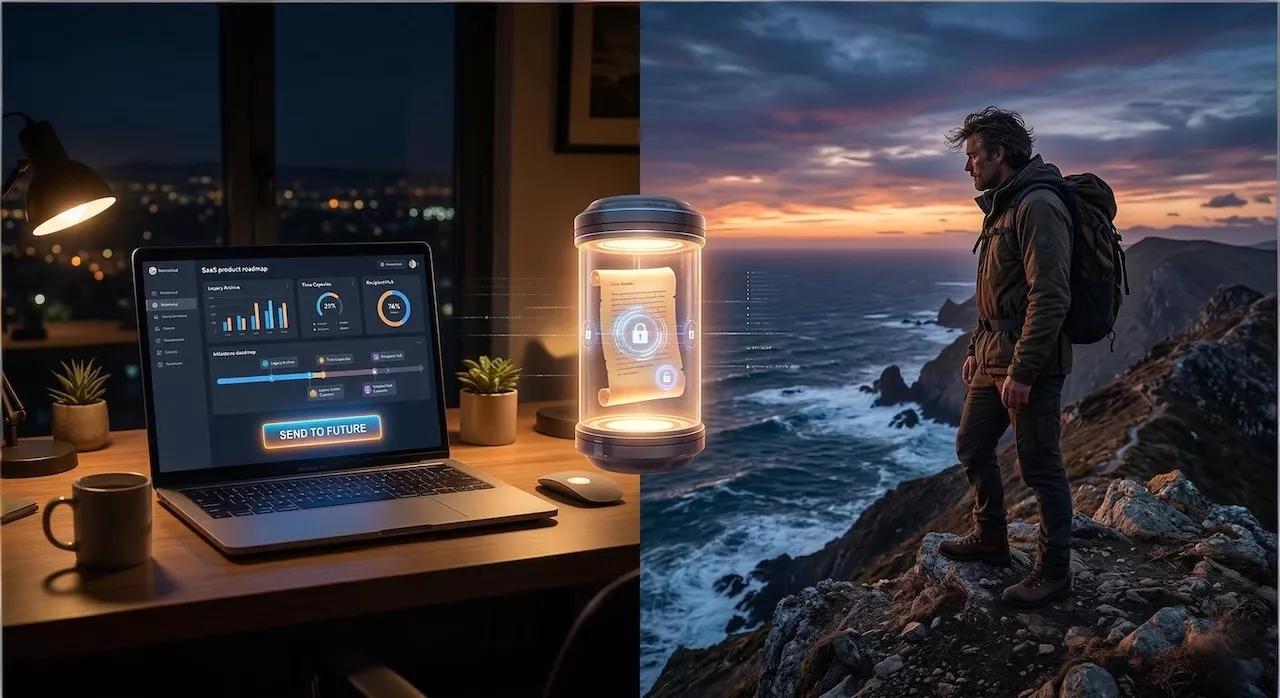
Why I Built EterMail: A Time Capsule for the People I Love Most
I’m a Product Manager who spends all week optimizing for the "immediate now." But getting lost off the grid on a mountain ridge made me realize I had zero infrastructure for the "forever." Here’s why I stopped worrying about conversion rates for a moment and built EterMail—a secure, tamper-proof digital time capsule for the people I love most.

The Solo Cello: On Reclaiming the Car, the Radio, and the Road After Loss
What happens when you finally change the radio preset they programmed? A meditation on vehicular grief, small ceremonies of letting go, and learning to carry only one.
The Metronome We Become: How Parenting Rewrites Our Internal Rhythm—and What Remains When They Outpace Us
What happens when our children outgrow the tempo we slowed our lives to teach them? Explore the quiet grief and grace of parental rhythm, and how to preserve it.