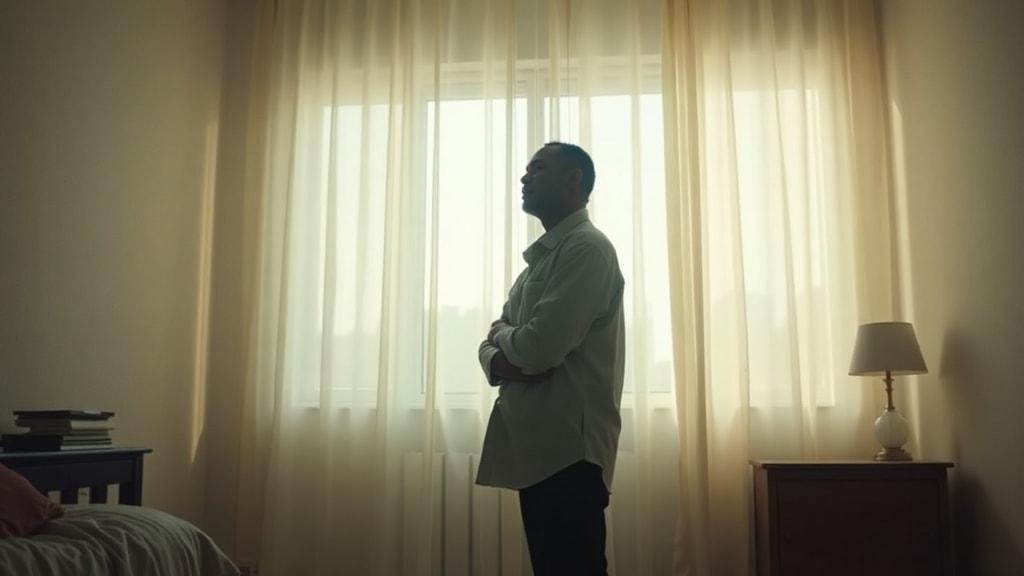
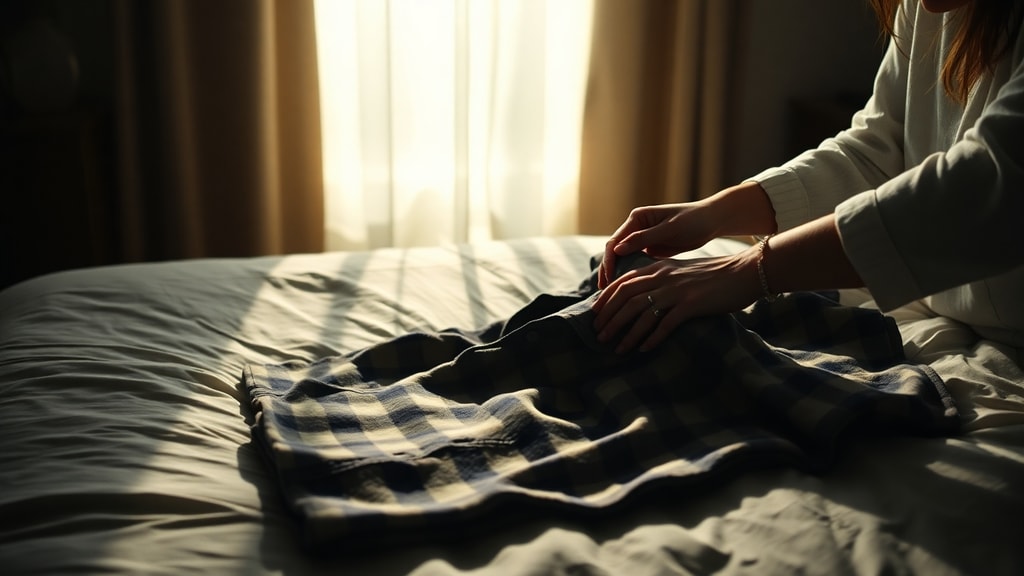
The evening you finally fold their laundry—socks still paired the way they liked, t-shirts inside-out the way they always took them off—and you don't set the stack on their side of the dresser, you carry it straight to your own drawers. You wear their favorite shirt the next day without ceremony. No photograph, no announcement, no weighted moment of decision. Just the ordinary act of getting dressed, and somewhere in that ordinariness, the first true breath after drowning.
This is not the grief you expected. This is quieter. Stranger. More intimate than any eulogy.
The Geography of Absence
For months, maybe years, their clothes occupied a territory you could not cross. The left side of the closet. The bottom drawer they always reached for first. You preserved these spaces like museum exhibits, touching nothing, as if keeping the arrangement intact might summon them back or at least keep the shape of their absence recognizable.
You dressed around them. Chose colors they never wore. Avoided the belt you bought together in that shop in Lisbon. Their denim jacket hung on its hook like a ghost you were too polite to address.
Grief counselors call this "maintaining the environment"—a form of bargaining with reality, as if the material world might outlast your acceptance of what happened. The clothes stay folded their way. The fabric softener stays theirs, though you never much liked it, because changing it would mean they are truly not coming back to notice.
The First Transgression
The shift rarely announces itself. Perhaps you spill coffee on your only clean shirt and grab theirs without thinking. Perhaps you're cold at 3 AM and their sweater is closer than yours. Perhaps you simply run out of underwear and theirs fits, more or less, if you tighten the drawstring.
The first time feels like theft. You half-expect to be caught, to turn and find them in the doorway with that particular expression—amused, slightly offended, "That's mine." The silence that answers is its own punishment. You take it off. You put it back. You do not sleep.
But then it happens again. And again. Each time with less ceremony, less guilt, less of the performative grief you've been practicing. The shirt goes into your laundry basket. The sweater stays on your body through breakfast. The belt, notched one hole tighter because you are not the same shape they were, holds up your pants to work.
The Alchemy of Scent and Memory
Scientists have documented what mourners already know: scent is the sense most directly wired to emotional memory, bypassing the thalamus to strike the amygdala and hippocampus directly. Their fabric softener becomes your scent not by choice but by neurological conscription. You smell them on your own skin, and the brain cannot immediately distinguish between presence and trace.
This is why the transition hurts with such specific precision. You are not merely wearing their clothes. You are inhabiting their olfactory signature, confusing your own animal self. The first time someone compliments your fragrance and you realize it's not yours at all—it's the ghost of their detergent, their skin chemistry, the particular way their sweat interacted with cotton over years of shared washing machines.
You consider switching brands. You do not. The grief has become, without your permission, something you wear.
The Wedding Ring in the Drawer Beneath the Socks
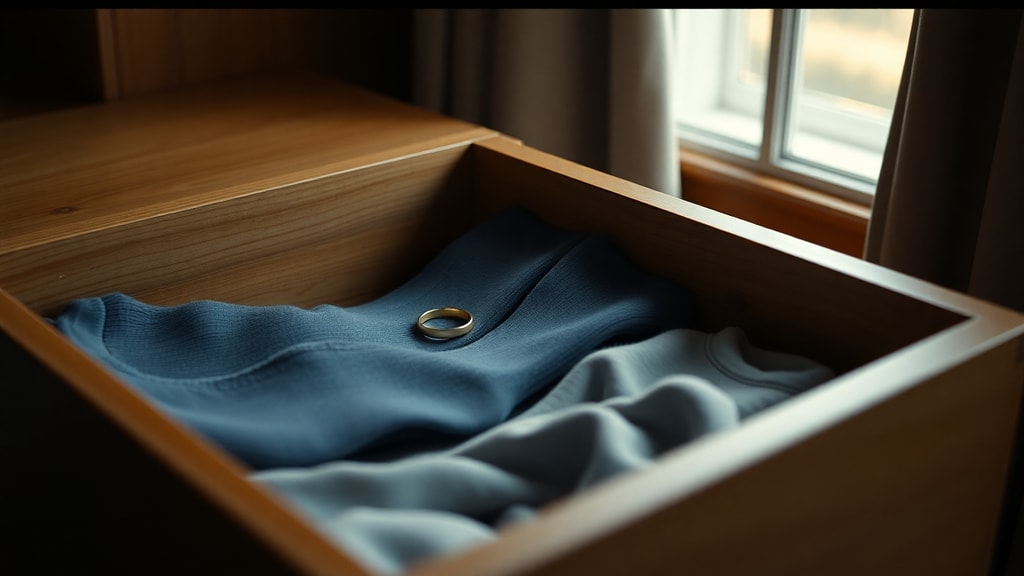
Jewelry operates on different rules. The wedding ring you finally stop wearing on your right hand—the widowed compromise, the public signal of continued allegiance—slides into a drawer beneath the socks. Not discarded. Not displayed. Simply stored among the ordinary, where you will encounter it unexpectedly and feel, each time, a different weight.
This is the geography of moving forward without moving on: the ring becomes occasional rather than constant, the clothes become functional rather than relic. You are not forgetting. You are redistributing the concentration of your devotion across time rather than maintaining it as a fixed, exhausting monument.
Some days you take the ring out and hold it. Some days you forget it exists. Both are honest. Both are grief.
Costume or Continuation?
The fear, unspoken until now: that wearing their clothes is performance, cosplay, a refusal to accept your own singular existence. You worry that others see you as stuck, as unable to let go, as playing dress-up with a life that no longer exists.
But continuation is not costume. The body they loved becomes the body that outlives them—not by erasing your form but by layering it. Their shirt over your shoulders, their belt around your waist, these are not disguises but collaborations across time. You are wearing what they chose, what they touched, what they wore into their own ordinary days, and in doing so you are refusing the binary of "them" or "me."
The philosopher Roland Barthes, mourning his mother, wrote of her "truth" residing in the trivial details of her life—the way she prepared a dish, the way she said a word. We do not memorialise the great events, he suggested, but the grain of the everyday. Their clothes are the grain of their everyday, and wearing them forward is a way of saying: your truth continues in my trivialities. Your preferences shape my mornings. Your taste becomes, gradually, mine.
The Belt Notched One Hole Tighter
The physical facts of inheritance are inescapable. Their belt requires adjustment. Their shoes are half a size different. Their shirts hang looser or pull tighter across shoulders that never carried their particular tensions. You do not become them. You become yourself wearing them. The notch you choose is your own compromise, your own geography.
This is where healing lives: not in the erasure of difference but in the negotiation of it. You are not performing their life. You are continuing your own with their materials, the way a composer might incorporate another's melody into a new key, a new tempo, a new century.
The Life They Left Behind
There comes a morning when you reach automatically for their sweater, not because you are sad, not because you are remembering, but because it is cold and this is the warmest thing you own. The grief has become, without ceremony, simply your wardrobe. The distinction between "their clothes" and "my clothes" has dissolved into the practical taxonomy of what fits, what flatters, what you actually want to wear.
This is not betrayal. This is the body continuing its work of living, and finding, in the materials left behind, sufficient resources for that work. The life they left behind is not a museum. It is a wardrobe, a kitchen, a garden—spaces that require use to remain meaningful, that decay through preservation and thrive through incorporation.

What We Leave and What We Take
The inverse truth, rarely examined: we are all, eventually, leaving our clothes to someone. The favorite shirt, the worn jeans, the jacket with the particular stain from that particular night. We do not choose this legacy. We do not curate it. We simply wear things until we cannot, and then someone else must decide: preservation or use, museum or wardrobe, ghost or continuation.
I think about this more than I probably should. There are nights when I'm up until 2 or 3 AM, "pair programming" with some LLM or mapping out architectures, and the solitude gets so deep it stops feeling lonely and starts feeling like a conversation across time. That's the strange resonance I feel with this whole idea—of leaving something behind that someone else will eventually fold into their own life. It's why I became obsessed with building bridges between physical and digital existence, why I see code as a way to keep human presence alive past the moment of creation.
The question of digital legacy operates in parallel. The photos we store, the messages we send, the voice memos we forget we recorded—these too become materials someone must inherit, must decide how to wear forward. But here's the difference: we can choose these inheritances deliberately. We can write the letter to our future self, knowing exactly what that self will need to hear. We can schedule a message for our child's thirtieth birthday, long after we might be gone to explain why our closet held clothes that once belonged to someone they never knew.
This is exactly why I obsessed over end-to-end encryption and extreme server redundancy when building EterMail. Because I know that a letter written to the future needs to be guarded even more fiercely than a bank password. The words we send across time deserve the same fierce protection we give our financial data—more, actually, because these words carry the weight of presence, of voice, of the particular way we said things that no one else could replicate.
<
The Ordinary Miracle of Getting Dressed
You stand before the mirror in their shirt, now yours. The fabric softener has faded through enough washings that it is neither fully theirs nor fully yours, but some third thing: the scent of continuation, of grief metabolized into ordinary living. You do not photograph this. You do not narrate it. You simply go to work, buy groceries, meet a friend for coffee.
The healing is not in the wearing but in the unceremoniousness of it. The moment when their clothes become simply clothes, their preferences become simply your preferences, their absence becomes simply the space you now occupy—this is not closure, which is a fiction, but continuation, which is the only honest form of survival.
The socks still paired the way they liked. The t-shirts still inside-out, because you have adopted their habit, because it is easier, because it is now your habit too. The stack goes to your drawers. The body they loved goes on living, dressed in the life they left behind, neither costume nor denial but the simple, strange, intimate work of wearing grief until it becomes, finally, indistinguishable from comfort.
The Letters We Wear Forward
There are other inheritances we might choose more deliberately. The letter written to a future self, to be opened when the fabric softener has fully faded. The message to a child not yet old enough to understand why your closet contains clothes that once belonged to someone they never knew. The voice memo scheduled to arrive on an anniversary, when you will need to hear, in your own past voice, that you survived this once and will survive it again.
These too are garments of a kind: words worn across time, fitted to shoulders that will be different shapes when they finally arrive. The technology of scheduled messaging, of digital time capsules, of letters that outlive their writers—this is the equivalent of leaving your clothes not in a drawer but in a future, to be unfolded when needed, to be worn until they become, gradually, the recipient's own.
The evening you finally fold their laundry and carry it to your own drawers, you are performing an ancient ritual of continuation. The body that outlives. The wardrobe that outlives. The love that becomes, through ordinary use, not less but differently present—worn in, worn forward, worn until it is simply the way you live now.
What is EterMail?
EterMail is a revolutionary time capsule service that allows you to send messages, photos, and videos to the future (up to 30 years). Seal your memories and thoughts today, and they'll be delivered when the time is right.
Time Capsule
Send messages up to 30 years in the future
Rich Media
Text, photos, and videos supported
Secure & Private
Your memories are safely encrypted
EterMail Team
We're the team behind EterMail, dedicated to helping you preserve and share timeless messages with your loved ones. Our mission is to make it easy to express your love, share your wisdom, and create lasting connections that transcend time.
Frequently Asked Questions about Healing & Remembrance
How do you cope with wearing a deceased loved one's clothes without feeling guilty?
What should I do with clothes I can't bear to wear but don't want to discard?
Is it healthy to keep a deceased spouse's wedding ring after remarrying or moving forward?
Related Articles

The Solo Cello: On Reclaiming the Car, the Radio, and the Road After Loss
What happens when you finally change the radio preset they programmed? A meditation on vehicular grief, small ceremonies of letting go, and learning to carry only one.
The Unpotted Plant: On Healing When You Finally Stop Keeping Something Alive
What happens when you stop performing care for a life that was never yours to keep? A meditation on grief, the objects we inherit, and the strange relief of letting something die.

The Morning You Forget Which Side Was Theirs: On the Geography of Grief and the Slow Work of Remembering
What happens when you forget which side of the bed was theirs? A meditation on the strange, intimate geography of grief and how we learn to remember without pain.