
There is a particular loneliness that lives in the body long after a relationship ends. It settles between the shoulder blades, in the hollow of the throat, in the precise acreage of mattress you learn to claim as your sovereign territory. You become an expert at the edge. You master the art of not rolling, of not reaching, of not making a sound when you wake at 3 AM with your heart hammering out some dream you can't remember. The bed becomes a performance space, and you its sole, exhausted actor.
Then someone new happens. Or rather, you let someone new happen. And the body, that stubborn archive of memory, must be re-educated entirely.
The First Night You Don't Lie Rigid
The milestone announces itself quietly. You are lying beside them, fully clothed in your caution, when you realize your hips have softened into the mattress. Your shoulders have released their perpetual shrug. You have not, for the past twenty minutes, been calculating the exact distance between your spine and theirs. You have simply been lying there.
This is not the romance of films. There are no candles, no swelling scores. There is only the shock of your own breathing, which has slowed without your permission. The body remembers before the mind permits. The first night you don't lie rigid is the night your nervous system votes for trust before your conscious self has finished counting the risks.
You will not notice this milestone in the moment. You will notice it weeks later, when you try to sleep alone in a hotel room and find your body searching for warmth that isn't there, confused by the sudden abundance of space.
The Pillow That Doesn't Smell Like Your Ex
There are objects that carry more grief than photographs. The pillow you finally replace. The sheets you wash with a new detergent, not because the old one was bad, but because it was theirs, because scent is the most direct route to memory and you are tired of arriving there every night.
You buy a pillow that doesn't smell like anyone. It is aggressively neutral, hotel-anonymous, and you hate it for three nights. Then you don't. Then you bring it to their apartment, and it absorbs the new smell, and you feel something complicated—not betrayal of the past, but permission for the present.

The objects we sleep with are witnesses. They absorb our nightmares, our sweat, the tears we pretend are allergies. Replacing them is a burial and a birth simultaneously. The pillow that doesn't smell like your ex is not a rejection of what was—it is the body's insistence on remaining available to what might be.
Matching Your Breathing to Theirs
Insomnia wears many disguises. Sometimes it is the inability to fall asleep. Sometimes it is the inability to stay asleep. Sometimes it is the ability to sleep only when no one is watching, when the performance of rest can finally cease.
You lie awake beside them, rigid again but for different reasons. You do not want them to know. You do not want to be the person who cannot do this basic human thing, who cannot surrender consciousness in the presence of another. So you match your breathing to theirs. You steal their rhythm, let their lungs teach yours the tempo of rest.
This is not deception. This is the oldest form of learning—mimicry, mirror neurons, the way infants regulate through their mothers' bodies. When we match our breathing to another's, we are practicing a kind of borrowed trust. We are saying: I do not yet know how to do this alone, but I can follow you until I find my way.
There will be nights this fails. Nights you slip out to pace the living room, nights you lie rigid again, nights you wonder if you are broken in some fundamental way. These nights do not undo the progress. They are part of it.
The Morning Your Limbs Have Tangled Without Permission
You wake to find your leg thrown over theirs, your hand curled into the furnace of their lower back, your hair wound into their pillowcase like something growing. You do not remember crossing the distance. You do not remember deciding to touch.
This is the milestone that cannot be performed. You cannot fake unconscious choreography. You cannot will your sleeping body to trust. The morning you wake tangled is the morning your body has voted more decisively than your conscious mind ever could. It has said: this person is safe enough to hold while I am not looking.
You will lie still, not wanting to disturb this evidence. You will memorize the angle of their collarbone, the particular temperature of their sleep-warmed skin. You will feel something like grief for all the mornings this did not happen, all the years your body kept its own counsel, all the nights you woke alone and did not know you were lonely.
The Night You Finally Cry and They Don't Wake
There comes a night when the grief arrives unscheduled. Not the dramatic grief of breakups, but the ordinary grief of being human—of parents aging, of opportunities missed, of the particular loneliness of being alive in a body that will not last. You are lying beside them, and the tears come, and you do not suppress them.
They do not wake. Their breathing continues its reliable rhythm. They do not witness, do not comfort, do not perform understanding.
And somehow this feels safer than being witnessed.
There is a profound intimacy in being allowed to cry without consequence, without explanation, without the labor of making your pain legible to another person. Their unconscious presence becomes a kind of container—not for fixing, but for holding. You learn that love can be present without being alert, that devotion does not require consciousness to be real.

This is the milestone that contradicts everything we are taught about intimacy. We are told that love is witnessing, is active presence, is the deliberate choice to show up. We are not told that love is also the trust to fall apart while someone sleeps, the faith that your unguarded sorrow will not be punished by their alarm.
The Bladder, The Warmth, The Surrender
You have held your bladder through entire nights, you realize. Not because the bathroom was inaccessible, but because getting up would mean disturbing the shape of shared rest. You would lie in discomfort rather than risk the cold return to a bed that had forgotten your warmth.
Then one night you don't. You get up. You come back. They have not noticed, or they have noticed and not minded, or they have shifted to make room for your return. The bed receives you again. The warmth reconstitutes itself around your shape.
This is the geometry of shared life: the learning that your needs do not destroy the whole, that the system of two can absorb your individual movements without collapsing. The bladder becomes metaphor. The getting-up becomes practice for all the larger disruptions you will inevitably bring to each other—your depressions, your ambitions, your sudden needs to be elsewhere.
The One-Third of Life We Cannot Perform
We sleep, if we are lucky, one-third of our lives. This is the portion we cannot curate, cannot perform, cannot protect with wit or charm or careful self-presentation. In sleep we are ugly, we are vulnerable, we are drooling and snoring and talking nonsense. We are, in the deepest sense, unavailable.
The truest milestone of love is not the declaration in daylight, the ring, the public commitment. The truest milestone is the courage to be unconscious together, to surrender the one-third of your life you cannot monitor, and to trust that devotion persists in the hours you cannot verify.
This is why sleeping beside someone again, after you have learned to sleep alone, is its own heroism. The body remembers betrayal. The body remembers the particular safety of solitude, where no one can leave because no one is there. To choose shared rest again is to override this archive, to teach the nervous system a new story through repetition and warmth and the slow accumulation of undisturbed nights.
I know something about this archive, about the stubbornness of bodies and the slowness of trust. For years I sat alone until 2 or 3 AM, pair-programming with LLMs, mapping architectures in the blue glow of a screen that asked nothing of me. That digital solitude taught me its own comfort—the safety of interfaces that don't leave, that don't breathe, that don't require your unconscious surrender. But it also taught me the hunger underneath: for warmth that moves on its own, for trust that must be earned in darkness rather than compiled in light. The mountains I hike on weekends, the raw wind that strips away every illusion of control, those moments remind me that the unrepeatable present is worth the risk of fragility. Building EterMail came from this same place—wanting to build bridges between the physical and the digital, to make technology serve the softest, most human needs rather than replace them.
What We Might Preserve of This
There will come nights, years from now, when you want to remember this. Not the grand events—the weddings, the moves, the announced commitments—but this specific phase of bodily re-education. The first night you softened. The morning you woke tangled. The night you cried and were not witnessed, and felt held anyway.

These are the milestones that slip through the cracks of conventional memory. We do not photograph them. We do not announce them. They leave no physical trace except, perhaps, in the body itself, which carries its history in posture and breath and the particular way it settles into sleep.
Some things deserve to be preserved despite their invisibility. The quiet courage of learning to rest beside another person. The trust built not through words but through shared unconsciousness. The love that persists even—especially—in the hours we cannot monitor.
The best way to fight forgetting isn't taking another screenshot; it's setting an alarm for the future. By using EterMail to set a delivery date 5 years from now, you completely free yourself from the anxiety of the present. Write to the person sleeping beside you tonight. Describe the angle of their collarbone, the particular temperature of their sleep-warmed skin, the way your leg found theirs without permission. Seal it. Let time hold it until you both need to remember who you were in the dark, together.
The body learns slowly and forgets slowly. What it learns in the dark, together, becomes part of how we are available to the world when we wake.
The milestones that matter most are rarely the ones we plan. They arrive in ordinary moments—in the softening of a shoulder, the tangling of limbs, the courage to cry without being witnessed. What would you preserve of your own quiet revolutions?
What is EterMail?
EterMail is a revolutionary time capsule service that allows you to send messages, photos, and videos to the future (up to 30 years). Seal your memories and thoughts today, and they'll be delivered when the time is right.
Time Capsule
Send messages up to 30 years in the future
Rich Media
Text, photos, and videos supported
Secure & Private
Your memories are safely encrypted
EterMail Team
We're the team behind EterMail, dedicated to helping you preserve and share timeless messages with your loved ones. Our mission is to make it easy to express your love, share your wisdom, and create lasting connections that transcend time.
Frequently Asked Questions about Love & Milestones
Why is sleeping next to someone considered a relationship milestone?
How do you get comfortable sleeping with a new partner after being single?
What does it mean if you still can't sleep well with your partner after months?
Related Articles

The Architecture of Coupled Privacy: Why the Deepest Love Lives in the Vault
What if the truest milestone is not the love we display, but the courage to carry what we know alone? Explore the vault of coupled privacy.

The Night We Stayed: How Love's Unspoken Milestones Rewrite Who We Become
What if love's truest milestone isn't the celebration—it's the night you choose to stay on the bathroom floor when everything falls apart.
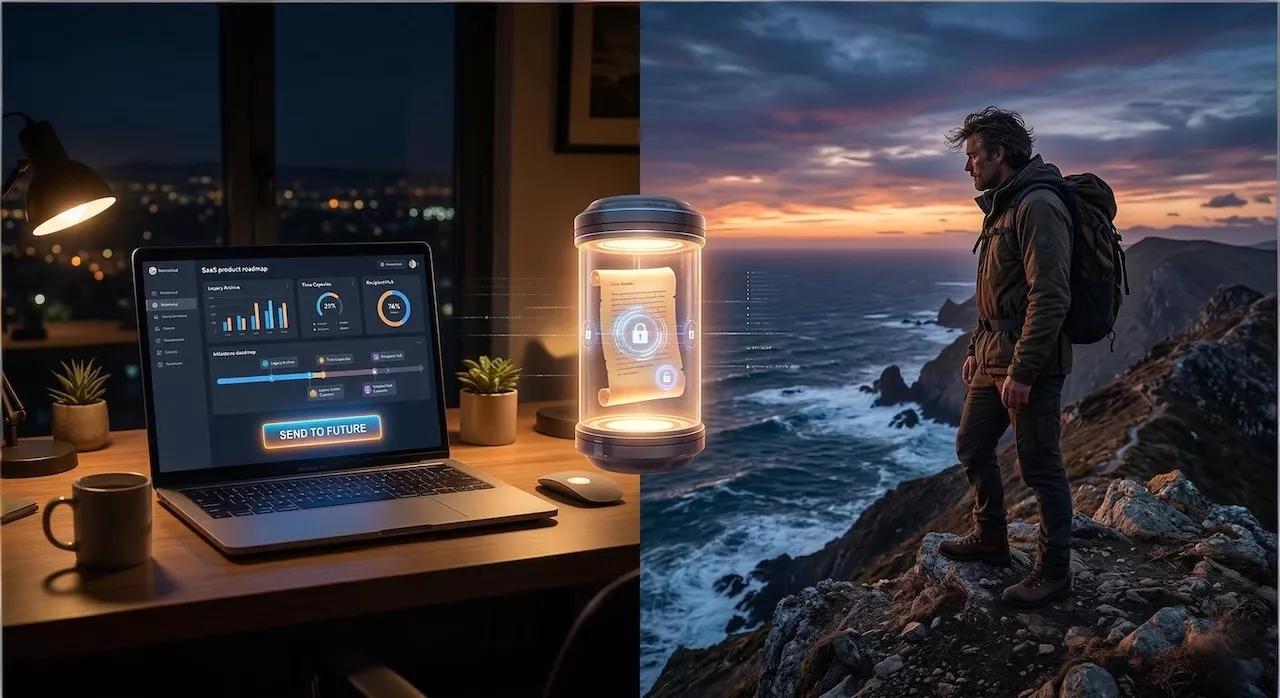
Why I Built EterMail: A Time Capsule for the People I Love Most
I’m a Product Manager who spends all week optimizing for the "immediate now." But getting lost off the grid on a mountain ridge made me realize I had zero infrastructure for the "forever." Here’s why I stopped worrying about conversion rates for a moment and built EterMail—a secure, tamper-proof digital time capsule for the people I love most.