AI marketing agents: what they are, what they can do today, and how to choose one safely
What an AI marketing agent is, what content, email, ads and analytics agents can and can't do today, where to keep human approval, and how to choose one.
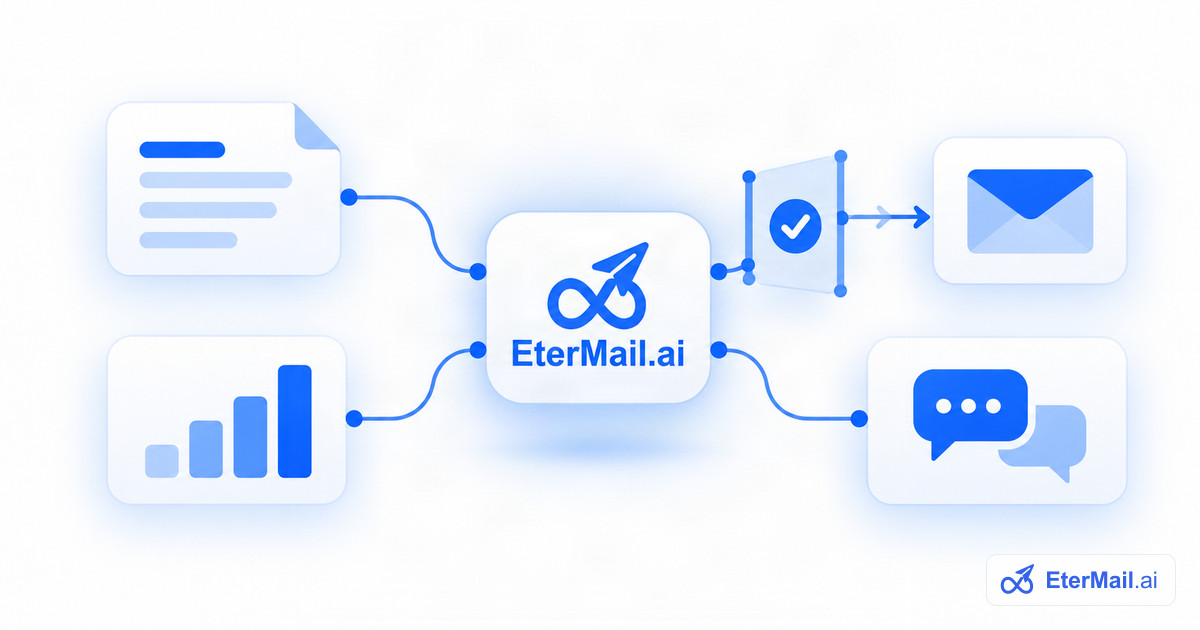
An AI marketing agent is software that takes a marketing goal, works out the steps, and carries some of them out using real tools: your email platform, your ad account, your analytics. That last part is what separates an agent from a chatbot. A chatbot gives you text to copy. An agent can build the segment, draft the campaign and schedule it.
That makes agents useful, and it makes the question "what is it allowed to do without asking?" the most important one you'll answer when you adopt one. This guide explains what AI marketing agents are, what they handle well today, where they still fall short, how to think about human approval, and a checklist for evaluating one.
What is an AI marketing agent?
Most AI marketing tools sit somewhere on a spectrum:
| Type | What it does | Example |
|---|---|---|
| AI writing assistant | Produces text when you ask | "Write three subject lines for our sale" |
| Rule-based automation | Runs steps you defined, no AI judgment | A welcome email sent when someone subscribes |
| AI agent | Plans steps toward a goal and uses tools to do them | "Win back customers who haven't ordered in 90 days": finds them, drafts the emails, proposes a send |
An agent typically has four parts:
- A goal in plain language ("increase repeat orders this month").
- Context: your brand, products, customers and past results, read from connected systems.
- Tools: actions it can take, such as creating a segment, writing a draft, changing a budget or pulling a report.
- Limits: what it may do on its own, what needs a person's approval, and what it can never touch.
Many agents now connect to tools through the Model Context Protocol (MCP), which its documentation describes as "an open-source standard for connecting AI applications to external systems." In practice, MCP is how a general assistant like Claude or ChatGPT can work inside your marketing tools instead of only talking about them.
The four main categories
Content agents
Content agents research topics, draft blog posts, landing pages and social posts, and repurpose one piece into many formats. Many marketing suites and standalone writing tools now include them.
Good at: first drafts, variations, summaries, adapting tone to a style guide, turning a webinar transcript into five posts. Weak at: original insight, first-hand experience, fact-checking their own claims, and knowing which of your products is out of stock this week.
Email and lifecycle agents
Email agents build audiences, draft campaigns and automated flows, and report on results. As of October 2026, Klaviyo's product page describes Composer, its AI marketing agent: "Describe the outcome you want, and Composer builds the audience, drafts the content" and prepares the campaign for review; the page says you can review customer-facing work before it goes live. HubSpot's knowledge base lists agents such as a prospecting agent that researches target companies and drafts personalized outreach, and a customer agent that responds to support conversations.
Good at: turning a request into a segment plus a draft, writing on-brand variations, summarizing which campaigns and flows earned the most. Weak at: judging whether an offer is wise for your margins, or whether your list has had too much email this week.
Advertising agents
Ad platforms have automated more and more of the campaign for years. Google describes Performance Max as "a goal-based campaign type that allows you to access all Google Ads inventory": you set conversion goals and supply text, images and video, and Google's systems handle bidding and combine your assets into ads across its channels.
Good at: bidding, budget pacing across placements, creative combinations at a scale no person could manage by hand. Weak at: transparency (you often can't see exactly why a placement was chosen), and protecting your brand from placements or combinations you wouldn't have picked.
Analytics agents
Analytics agents answer questions about your data in plain language: "Why did revenue drop last week?", "Which flow has the worst unsubscribe rate?" They pull numbers from connected systems and explain them.
Good at: quick answers, spotting changes, writing the weekly summary. Weak at: causation. An agent can tell you open rates fell; it may not know that a mailbox provider changed how opens are counted, that your sending domain changed, or that the sale ended. Treat explanations as hypotheses.
What AI marketing agents can't do (yet)
Agents are improving quickly, but some limits hold across categories today:
- They don't know what isn't in their data. A supplier delay, a product recall, a promise the founder made on a podcast: if it isn't in a connected system, the agent can't account for it.
- They can state things confidently that aren't true. Prices, product claims, shipping promises and "limited time" statements all need checking against the source.
- They can be steered by what they read. The OWASP Top 10 for LLM Applications (2025) lists prompt injection as its number one risk (LLM01:2025): input that changes how a model behaves in ways the developer didn't intend. For a marketing agent, that input could be a customer email, a product review or a web page it reads.
- They can be given too much power. The same OWASP list names "Excessive Agency" (LLM06:2025): AI systems granted more ability to act than they need.
- They don't carry accountability. If an email makes a claim your regulator objects to, or goes to people who unsubscribed, the responsibility is yours, not the model's.
None of this means you shouldn't use agents. It means you decide in advance where a person stays in the loop.
Human approval and guardrails
Think of autonomy as levels, and choose one per action, not per tool:
| Level | The agent... | Suitable for |
|---|---|---|
| 1. Suggest | Recommends; a person does it | New tools, new teams |
| 2. Draft and approve | Prepares the work; a person approves before it takes effect | Sends, replies, spend changes |
| 3. Act within limits | Acts alone inside set rules, and tells you | Routine, reversible, well-understood tasks |
| 4. Fully autonomous | Acts with no checks | Rarely appropriate in marketing |
A practical rule: keep approval on anything customer-facing or hard to undo. A sent email can't be recalled. A deleted list doesn't come back. A budget overspend is real money. Reading reports, drafting and building segments are low-risk and can usually run freely.
Guardrails to look for, whatever the tool:
- Scoped access: read-only versus read-and-change, chosen per connection.
- Approval by action type: sending, deleting, replying and importing handled separately.
- Locked approvals: once you approve a version, any edit needs a fresh approval.
- Automatic stops: sending pauses when bounces or complaints spike, whatever the agent wants.
- Off-limits areas: payments, API keys, passwords and DNS should never be reachable by an AI agent.
- An audit log: who approved what, and when.
- Consent checks at send time, not only at list build time, so an agent can't email someone who unsubscribed an hour ago.
How to evaluate an AI marketing agent
Use this checklist in a trial, with your own data and a small audience:
- Scope. Which tasks does it actually do end to end, and which does it only draft? Ask for a demo of your use case, not the vendor's.
- Data. What does it connect to, and with what permissions? Can you limit it to read-only?
- Approval model. What can it do without asking? Can you change that per action type? Is approval required by default?
- Brand fit. Does it learn your voice and products, or produce generic copy you'll rewrite anyway?
- Accuracy. Give it ten real requests. Count how many outputs contain a wrong price, product, date or claim.
- Transparency. Can you see what it did, why, and what data it used?
- Safety. How does it handle instructions hidden in content it reads? What can it never access?
- Cost. Is AI billed per seat, per action or by usage? Agents can make many calls behind one request, so model the bill at your real volume.
- Exit. If you stop using it, do your drafts, segments and data stay in your systems?
Start with level 2 (draft and approve) on one workflow, such as a monthly win-back campaign. Run it for a month, track the edit rate (how much you change before approving), and widen the scope only when the edit rate is low and nothing slipped through.
EterMail: an AI email marketing team with approval built in
EterMail is our product: an AI email marketing platform for ecommerce, SaaS and apps, covering campaigns, automated flows, cold outreach and a unified inbox. The AI learns your brand from your website and drafts campaigns, flows and replies; AI can also make the pictures: on-brand banners, or scenes built from your real product photo, with an optional short greeting. Every send needs a person's approval by default, and an approved email is locked: any edit needs a fresh approval.
Two ways to work with it as an agent:
- Etta, the assistant built into EterMail. Ask it how last week went or why a flow slowed down, and it answers from your own numbers. It can also draft campaigns, build segments and prepare imports; anything that sends, deletes or imports waits for your approval. Etta tasks can run on a schedule or when a condition is met (say, a campaign's click rate falls below a threshold); changes they propose still come to you for approval, unless an owner or admin has approved an auto-send rule for that task.
- The EterMail MCP server, for Claude, ChatGPT and Cursor. You sign in with OAuth and choose read-only or read-and-change access. The app can look up results, write campaign and cold email drafts, and build segments and forms. Sending or scheduling, starting cold email, pausing or cancelling, deleting, replying to customers and importing contacts wait for you: the app gives you a link, you approve in EterMail, and the request lapses after 24 hours. An owner or admin can let a trusted app skip approval for some kinds of action; imports always ask, and payments, team members, API keys, mailbox passwords and DNS are never available to AI apps.
The setup steps are in Use EterMail in Claude, ChatGPT and Cursor, and AI email marketing shows what the AI writes. AI features are billed by usage; see pricing.
FAQ
What is an AI marketing agent?
An AI marketing agent is software that takes a marketing goal, plans the steps and uses connected tools to carry them out, such as building a segment, drafting an email or adjusting a campaign. Unlike a writing assistant, it can take actions in your systems, within the permissions you give it.
Can AI agents run marketing campaigns on their own?
Some can, technically, but full autonomy is rarely a good idea for customer-facing work. Most teams let agents draft and prepare campaigns and keep a person's approval on sends, spend and anything hard to undo. Choose tools that let you set this per action.
What is the difference between an AI agent and marketing automation?
Marketing automation follows rules you define: when X happens, send Y. An AI agent decides some of the steps itself to reach a goal, and can create new content and audiences along the way. Many teams use both: agents to build and improve flows, automation to run them reliably.
Are AI marketing agents safe to use?
They can be, with the right limits. Give the least access needed, keep approval on sending and deleting, make sure payments and credentials are out of reach, and watch for prompt injection from content the agent reads, which OWASP lists as the top risk for LLM applications.
How much do AI marketing agents cost?
It varies by vendor. Some include agents in a platform plan, some charge per seat, and others bill by usage, so cost grows with the number of tasks the agent runs. Check how the vendor bills and estimate it at your own volume before you commit.
Will AI marketing agents replace marketers?
Not today. Agents take over drafting, reporting and repetitive setup, but people still decide the strategy, the offers, the brand and what is true. The most useful setup pairs an agent's speed with a person's judgment at the approval step.