Klaviyo vs HubSpot: ecommerce email platform or all-in-one CRM?
Klaviyo vs HubSpot: an ecommerce email and SMS platform vs an all-in-one CRM. Who each suits, how they bill, automation depth. Official pages, Oct 2026.
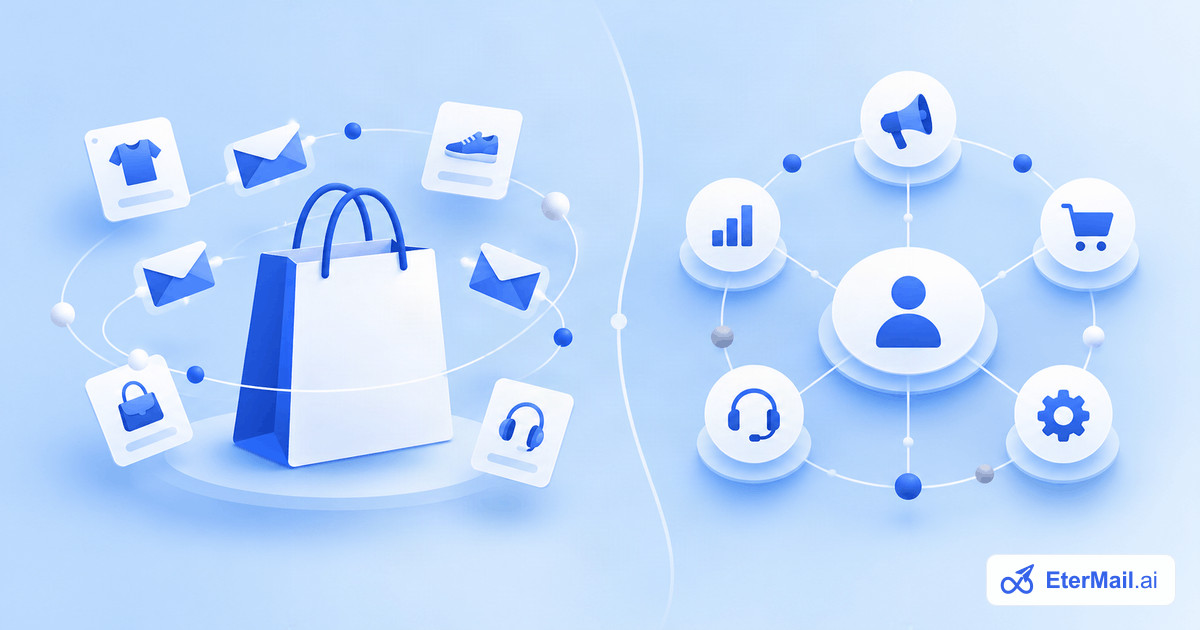
Klaviyo and HubSpot both send marketing email, both have AI agents, and both now call themselves CRMs. They're built for different businesses, though. Klaviyo is an ecommerce-native platform. It's organized around shoppers, orders and products, and sells email, SMS and a helpdesk around that data. HubSpot is an all-in-one customer platform. Marketing Hub sits next to sales and service tools on a shared CRM of contacts, companies and deals.
So the real question isn't which one has the better email editor. It's what kind of business you run. This guide walks through who each suits, how each bills, and how deep each goes on email and automation. Every fact about Klaviyo and HubSpot comes from their own pricing pages and help centers, read in October 2026.
Klaviyo vs HubSpot at a glance
| Klaviyo | HubSpot Marketing Hub | |
|---|---|---|
| Built around | Shoppers, orders and products | Contacts, companies and deals |
| Best for | Online stores (B2C ecommerce) | Businesses with a sales team or long sales cycle |
| Billed on | Active profiles, plus sends | Marketing contacts, plus seats |
| Free plan | 250 profiles, 500 sends/month | Free tools, 2,000 sends/month with branding |
| Onboarding fee | None listed | $3,000 (Professional), $7,000 (Enterprise) |
| SMS | Built in, billed separately from email | Add-on for Professional and Enterprise, US numbers |
| Store data | Deep Shopify integration | Shopify data sync (orders, carts, products) |
The short version: if you sell online to consumers and most of your marketing is email and SMS to shoppers, Klaviyo is the natural fit. If you have salespeople, deals and a pipeline to manage, and marketing needs to hand leads to sales, HubSpot is built for that.
Who each one suits
Klaviyo: built for online stores
Klaviyo's homepage now calls it "the autonomous B2C CRM". Underneath, it's still ecommerce email and SMS at heart. Every profile carries orders, products viewed and onsite behavior. Flows are triggered by shopping events, and analytics are about revenue per email, customer lifetime value and repeat purchase. The product line around it reflects that: SMS, WhatsApp and mobile push for marketing, a Helpdesk and an AI Customer Agent for shopper support, and Marketing Analytics for deeper reporting.
Klaviyo suits:
- Shopify and other ecommerce brands selling to consumers.
- Teams where email and SMS revenue is a main growth lever.
- Stores that want abandoned checkout, browse abandonment and post-purchase flows driven by real order data.
HubSpot: built for the whole customer journey
HubSpot describes Marketing Hub as "the platform where your CRM, content, and campaigns actually work together." It's one hub in a platform that also includes sales and service software, and the free HubSpot CRM underneath stores contacts, companies and deals. Marketing Hub covers email, landing pages, social media management, ads and AI agents. Its value grows when marketing and sales share the same records.
HubSpot suits:
- B2B companies and service businesses with a sales team.
- Businesses that need deal pipelines, lead nurturing and handoffs between marketing and sales.
- Teams that want marketing, sales and support in one system, even if some customers buy online.
What about stores that also sell B2B?
If you run a Shopify store *and* a wholesale or B2B sales motion, you'll feel both pulls. Some businesses use Klaviyo for consumer marketing and a CRM for the sales team. If you'd rather run one system, decide which motion brings in most of your revenue and pick the tool built for that.
Pricing model
These two bill in very different ways, and the gap widens as you grow.
How Klaviyo bills
Klaviyo prices its Profiles & Email plans by active profiles, meaning any profile you can email. Suppressed and unsubscribed profiles don't count, and neither do profiles with only a phone number. As of October 2026, from Klaviyo's pricing page and billing docs:
- Free: 250 active profiles, 500 email sends a month, $5 of mobile messages and $5 of Composer usage a month. Email support for the first 60 days.
- Paid: priced through a calculator on the pricing page. If your active profiles exceed your tier, you move up a tier at the next billing cycle.
- SMS and WhatsApp: billed separately from email, as a monthly spend amount that is used up as you send. Unused spend doesn't roll over.
- Add-on products: Helpdesk and Customer Agent are priced separately, by ticket and conversation volume.
- Billing cycle: all plans bill monthly. No onboarding fee appears on the pricing page.
How HubSpot bills
HubSpot prices Marketing Hub by edition, seats and marketing contacts. Marketing contacts are the ones you choose to email and target with ads. They count toward your paid tier. Non-marketing contacts can be stored for free, up to 15 million. As of October 2026, from HubSpot's pricing page:
- Free: free tools for up to 2 users, with 2,000 email sends a month and HubSpot branding.
- Starter: priced per seat, with 1,000 marketing contacts. HubSpot currently advertises a discount on Starter for new customers, so check the page for today's price.
- Professional: starts at $800 a month (the page shows a higher figure for some billing terms), with 3 core seats and 2,000 marketing contacts, plus a required one-time onboarding fee of $3,000.
- Enterprise: starts at $3,600 a month, with 5 core seats and 10,000 marketing contacts, plus a one-time onboarding fee of $7,000.
- Contact tiers: you can't lower your marketing contact tier until your contract renews.
- HubSpot Credits: AI agents and some automated actions use credits. Starter includes 500, Professional 3,000 and Enterprise 5,000, and extra credits cost $0.010 each.
What this means for your bill
For a small store, both have usable free tiers, but HubSpot's free email is tied to its branding and tight automation limits. The big jump comes when you need real automation. On HubSpot, full workflows live on Professional, which costs hundreds of dollars a month plus a $3,000 onboarding fee before you send anything. On Klaviyo, flows are available from the start, and cost scales with your active profiles.
HubSpot's marketing contacts model has one useful advantage for stores with many buyers you don't market to. You can keep them in the CRM for free and only pay for the ones you email.
Email and automation depth
Klaviyo flows
Klaviyo's automations are called flows. They can be triggered by shopping events such as Started Checkout, Added to Cart or Placed Order, and they branch on profile and order data. Klaviyo provides templates for the standard ecommerce flows: welcome, browse abandonment, cart and checkout abandonment, post-purchase and win-back. Composer, its AI marketing agent, can draft a campaign or flow from a prompt.
Segments are dynamic and can use full order history. With enough data, predictive analytics add predicted lifetime value, churn risk and expected next order date. Klaviyo's help center sets the threshold at 500 customers with orders, 180 days of order history with recent orders, and some customers with three or more orders. Our guide to email segmentation covers the segments most stores start with.
HubSpot automation
HubSpot's automation is split by edition. As of October 2026, its pricing page lists:
- Free: 1 automated action.
- Starter: up to 10 automated actions.
- Professional: unlimited actions, omni-channel automation and up to 300 workflows.
- Enterprise: up to 1,000 workflows.
HubSpot workflows run on the shared CRM, so the same automation tool serves marketing, sales and service, and Professional adds omni-channel automation. That breadth is HubSpot's strength. What HubSpot doesn't give you out of the box is Klaviyo's library of ecommerce flow templates built on shopping events. You'd build those yourself from Shopify cart and order data.
Example: an abandoned checkout flow in each
Here's an example of the same job in each tool.
- In Klaviyo: start from the abandoned checkout flow template. It triggers on Started Checkout, waits, and sends a reminder with the cart items. Klaviyo's help center recommends a filter so anyone who has placed an order since entering the flow is skipped.
- In HubSpot (Professional or higher): connect Shopify so abandoned checkouts sync in as Cart records. Then build a workflow that enrolls contacts with an open cart, waits, sends an email, and checks for a matching order before the next step.
Both can work. One is a template, the other is a build. For a deeper look at timing and copy, see our guide to Shopify abandoned checkout emails.
Shopify and store data
Klaviyo's Shopify integration brings customer profiles and orders into Klaviyo. With the app embed on, it tracks Viewed Product and Active on Site, and optionally Added to Cart, Viewed Collection and Submitted Search. It can sync Markets catalogs and write profile data back to Shopify, such as subscription status and email and SMS events.
HubSpot's Shopify data sync is available on all HubSpot plans. Contacts, companies (Shopify Plus only) and products sync both ways. Orders and abandoned checkouts sync one way into HubSpot. After the first sync, changes arrive within 10 minutes. Ecommerce reports are added to your account, and you can segment on cart and order records. HubSpot's docs list limits: product variants and Shopify metafields don't sync, and orders and carts aren't deduplicated automatically.
If you're a Shopify store weighing more options, including Shopify Messaging (formerly Shopify Email), our list of the best email marketing apps for Shopify covers them.
SMS and other channels
Klaviyo treats SMS as a core channel next to email, with MMS, WhatsApp, RCS and mobile push. Text is billed from a monthly spend amount, and rates vary by country.
HubSpot offers marketing SMS as an add-on for Marketing Hub Professional and Enterprise. Its knowledge base says SMS can only be sent from US-based numbers (long code numbers reach the US and Canada), each account gets a single marketing SMS number, and contacts need to give explicit SMS consent. Short code numbers need Enterprise plus an SMS Limit Increase add-on. HubSpot also lists WhatsApp, social media management and ads tools.
AI features
Klaviyo's K:AI includes Composer, a marketing agent that turns an idea into a campaign or flow, and Customer Agent, an AI support agent priced separately. It also lists predicted CLV, RFM analysis, churn risk, an AI image editor called Image Remix, and an MCP server for connecting AI tools to your data.
HubSpot's AI agents live in Agent Hub (formerly Breeze Agents). The pricing page lists Content Agent, Nurture Agent, Campaign Agent, Customer Agent, Prospecting Agent and Data Agent, with Content Agent and Nurture Agent marked beta. AI actions draw on HubSpot Credits included with each paid edition.
Both are moving toward agents that plan and build campaigns. Klaviyo's agents work from shopper and order data, while HubSpot's work from CRM records across marketing, sales and service.
Which should you choose?
Choose Klaviyo if
- You run an online store selling to consumers.
- Abandoned checkout, post-purchase and win-back flows are core to your revenue.
- You want SMS next to email, sent beyond the US and Canada.
- You don't need a sales pipeline or deal tracking.
Choose HubSpot if
- You have a sales team, a pipeline and leads that need nurturing before they buy.
- You want marketing, sales and service on one shared CRM.
- Content, landing pages, social and ads matter as much as email.
- You're ready for Professional-level pricing and onboarding when you need full automation.
If you're unsure
Ask where a new customer comes from. If the answer is "they find a product and check out", go Klaviyo. If it's "they fill in a form, talk to someone, then sign a contract", go HubSpot. If Klaviyo is on your shortlist, our Klaviyo vs Omnisend guide compares it with another store-first tool.
A third option: EterMail
EterMail is our product, so weigh this section accordingly. It's closer to Klaviyo's side of this comparison than HubSpot's. It doesn't do deal pipelines or SMS.
- AI drafts, a person approves. EterMail learns your brand and products, then drafts campaigns and flows: welcome, browse abandonment, abandoned checkout, post-purchase, win-back and custom events. By default, nothing is sent until someone approves it. AI can also make the pictures: on-brand banners, or scenes built from your real product photo, with an optional short greeting.
- You pay per email. 1,000 credits are $1, and a marketing email is 2 credits. Plans run from Free ($0, 1,000 credits, up to 1,000 contacts, no card) to Starter $19, Growth $49, Pro $149 and Ultra $299, with no onboarding fee.
- Stores and SaaS. Shopify connects through a read-only custom app. Stripe and a server API (identify, track, batch) cover SaaS and app data. Cold outreach from your own mailboxes and a shared reply inbox are included.
If you need a CRM for a sales team, HubSpot is the right tool, and EterMail won't replace it. See EterMail as a Klaviyo alternative for the store-side comparison.
FAQ
Can HubSpot replace Klaviyo for ecommerce?
It can, with work. HubSpot syncs Shopify orders, products and abandoned checkouts, and Professional workflows can act on them. But you'll build most ecommerce flows yourself, and SMS is an add-on sent from US-based numbers. Most consumer-focused stores find Klaviyo a closer fit.
Is Klaviyo a CRM?
Klaviyo now calls itself "the autonomous B2C CRM", and every profile holds orders, behavior and engagement. It's built around consumers and shopping data rather than deals and sales pipelines. If you need pipeline management for a sales team, HubSpot is the CRM built for that.
Why is HubSpot so expensive?
Full marketing automation in HubSpot sits on Marketing Hub Professional. As of October 2026, it starts at $800 a month with a required $3,000 one-time onboarding fee, and costs rise with seats and marketing contacts. You're paying for a whole platform shared with sales and service tools, not just email.
Can I use Klaviyo and HubSpot together?
Yes, some businesses do. They use Klaviyo for consumer email and SMS and HubSpot as the CRM for sales or B2B accounts. It adds cost and means keeping contact data and consent consistent between the two. Decide which system is the source of truth for marketing consent before you connect them.
Which is easier to learn, Klaviyo or HubSpot?
Both have a learning curve, for different reasons. Klaviyo asks you to understand flows, segments and ecommerce events. HubSpot asks you to understand a CRM data model and a broad set of tools. If your job is mainly store email, Klaviyo's scope is narrower and usually quicker to learn.